Showing posts with label Virtual content creation. Show all posts

Wednesday, January 5, 2011

"Rectangles R Us"--content creation for the clinically inept

~~~
I love Dusan Writer's blog. Even with the qualification that a good 30% of what he has to say goes completely over my head, I love to read his stuff. In the parts that I am able to comprehend, I always find something illuminating, thought-provoking, or just beautifully phrased. For example, I really enjoyed a piece he did back in late November about the idea that companies that are involved with "participant media" and building "digital communities" (such as Linden Lab does with Second Life) should value, engage, and jolly well make sure they retain the "clever people" among their customer base. He argues that particularly in a product like Second Life, the people who have the motivation, creativity and skills to create high quality content are vital to the health of the enterprise.

Sadly, however, Dusan concludes:

"...that Linden Lab has abandoned its 'clever people'.

The Lab turned its back on 'Your World, Your Imagination,' as Philip clearly did (and told me so, when I interviewed him at SLCC) and as others at the Lab continue to do.

In the discussions about mesh import, for example, Jack Linden made the point that 'there are very few creators' in response to my question about the cultural implications of mesh. This implies that the number is significant, and equates a one-to-one relationship between how many people there are and the influence they have on the culture of an online community.

Jack (and others) would say that mesh changes very little, it doesn’t shift the emphasis out of the in-world experience, because the number of creators is very small....But the larger significance is that the Lab’s principle concern is with a volume of people – that it’s the larger 'casual users' who matter, the users who haven’t even arrived yet. Philip said to me: “And most of them will never rez a prim, so it’s not really ‘Your World, Your Imagination’ because for them, they’re just shopping and hanging out.'

Which may be true (although I’d argue that you enter a world of your own imagination no matter WHO you are, when you arrive in Second Life and many other online platforms) but places a certain literal faith in the power of numbers alone."

I'm really glad there are bright people like Dusan who actually get to talk with the folks at the Lab, and who can come back with something for the rest of us to chew on. What is really fascinating to me in this particular discussion is the idea that it seems there are only two groups being focused on--the small minority that has wild skills and the hyper-creative warp drive to make really awesome shit, and the large majority of "casual users."

The thing that doesn't quite fit for me in that world view, however, is that I really believe that the majority--the big lumpy pile of avatar flesh and blingy bits called "casual users"--is actually more diverse and complex than the Labsters seem willing to acknowledge. I find it curious (and disturbingly revealing ) that Philip argued that in the case of the common garden variety boobis avataris, "most of them will never rez a prim."

Perhaps that was only hyperbole. I hope it was, because it is a view that misses the fact that there are a great many of us who might be considered causal users because we lack the skills to make wonderful content, but by golly, that certainly doesn't keep us from using at least some of the tools provided by the platform to make all kinds of crazy crap.

Let me offer up myself as an example:

I am
utter and inescapably digitally challenged; a recovering cyber-luddite with a limited range of skills. Yet that has not stopped me from being a sort of content creator in my own right. OK...yes, admittedly it is often pretty retarded stuff, but I have a hell of a lot of fun making simple bits and bobs and using them to enhance my experience and personalize my environment in-world. In fact, my friend September Blasidale (who has a similar skill level to mine in the content creation department) and I have decided to embrace our ineptitude and opened a vendor space in the Deadwood OOC area to hawk some of the less awful junk we have caused to appear in the pixelated vale of tears.

We have named our enterprise "Rectangles R Us"--because that's pretty much what we can handle: books, posters and pictures, a Hudson bay trade blanket, cigar boxes, ammo boxes....you get the picture. I have even produced a piece of furniture--a dry sink. In short, if it can be made from rectangular prims, we can pretty much deal with it without too much trouble. Sort of.

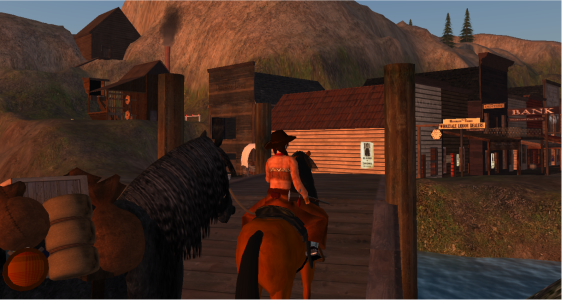
September and I at our booth in the Deadwood vendor area. And yes, rectangles are the predominant form of prim on the premises.


Look, I won't blow any smoke up yer hoohoo about it. I know my limitations. Sculpties scare me. Torturing a prim is torture for me. Hell's britches, it took me about a year to get around to putting a decent "squatting cross-legged" animation into that mashugana trade blanket, and even then I could only do it with guidance from Clay.

But I like the stuff I create. I have a great time either taking pictures of real-world stuff that I or my friends have (such as ammo boxes, antique beer ads, or the labels on vintage cigar boxes), or finding public domain images, and turning them into unique textures for what I want to make.

And the thing is, if I really put my mind to it, I probably could learn to make more sophisticated stuff--it's just that it would be an ugly and unappetizing process (think "making sausage"). Because let's face it, when it comes down to the bubble and squeak of creating content, I am a "casual user"...but it's certainly not a case of being someone who "will never rez a prim."

I believe that the creative potential of the platform is very important to me and people like me. No, we will never be super-duper "clever people." But I am convinced there are an astonishing number of us who fall into this sizable category that lies in between "the makers of really cool shit" and the folks who want to just hang out and shop (by the way, I fucking loathe shopping in SL almost as much as I do irl--but that's another story for another time).

I just hope that if Dusan is ever able to talk LL into not abandoning the "clever people," he might also convince them to not forget those of us who are among the "cheerfully inept."
~~~


Sunday, January 24, 2010

The Bakumatsu in Second Life -- sharing an interest in history

~~~
Looking out into the back garden at the House of Yagi Gennojo in Kyoto Bakumatsu--a sim representing aspects of life and politics in Japan's capital city during the 1860s--a time of great change and dramatic conflict.

The other day, I was casting around for something new to go see in terms of history-related builds in SL, and my friend Ernst Osterham asked if had seen the sims representing Nagasaki and Kyoto in the 1860s. I admitted I had not, and at the first opportunity, popped over to see what is best described as the "Bakumatsu" build: three adjoining historically-themed sims dealing with the end of Japan's Shogunate era.

I am indebted to Ernst for the suggestion to visit this intriguing and well-constructed effort.

You know, much of what keeps me interested in Second Life is what various residents do in terms of exploring stories that are important to them. The ability to interpret or recreate historical environments fosters a delightful range of learning opportunities and various "aha" moments.

Some of those learning opportunities are entirely self directed, as in situations where a concept (like the Deadwood sim) and/or an activity (like Western frontier roleplay) draws you in and encourages you to learn new things. I honestly knew damned little about the American Western frontier and things like gold mining before I started playing in the Deadwood sim. Now mind you, the build and the roleplay didn't necessarily teach me these things. What it did do was to inspire me to study and learn about a range of new subjects, and to immerse myself in stories from a part of America's past that had only marginally interested me before.

Ah, but a slightly different kind of learning took place for me in the Bakumatsu sims. This build is literally an example of people from a background and heritage very different from my own, transporting me into a world of which I had only superficial knowledge from college courses I took almost 35 years ago. According the Bakumatsu sims manager Ryomo Sautereau (who is also one of the builders) this project was the result of collaboration among a group of SL residents from Japan who wanted to share a part of their history. They are not associated with a museum or university, but are simply a collection of Japanese history enthusiasts who have a fascination for this period known as the "Bakumatsu," which encompasses the years from 1853, when Commodore Perry's US Navy fleet of "black ships" pressured the Japanese to open their nation to trade with the western nations, to 1868, when the control of Japan by the Tokugawa Shoguns ended with the Meiji Restoration.

As I looked into this story (and some of my old Asian history studies came back to me), I could see why these folks are so intrigued by this time period: it was an era of great change for Japan not just politically, but also in terms of society and technology and religion. It was an era in which the Japanese people could see aspects of their ancient traditional way of life juxtaposed with the modern world, and they had to figure out how to reconcile those two realities. It's fun, exciting, and meaningful stuff.

Ryoma explained to me that the three sims actually have been around for some time: Kyoto Bakumatsu and Nagasaki Bakumatsu were built 3 years ago, and Kyoto Sanjo opened about a year later. A number of highly skilled builders were involved in this project--among those whose work you will see here are Senri Oh, Jeter Jun, Kuroe2 Noel, D15 Koba, Hiroe Jewell, and Ryoma. There are others as well, and I intend no slight to them and their work by not listing them all (and I apologize to those I missed in my cursory note taking), but a lot of people have contributed here. The remarkable thing about it is that even with all these different folks crafting the build, it has an astonishingly consistent feel to it. The scale, the authentic feel (even in the vendor areas), and the overall look works really well.

A clean and authentic feeling streetscape.

The way that it is structured is that the three sims generally have historical recreations arranged around their outer edges, while the central areas are commercial. In these center sections, you will find numerous blocks of historically-styled buildings that can be rented for vendor and social spaces. These include stores selling garments, skins, furnishings, weapons, etc., and while the products and environments all seem to express Asian traditions and generally utilize an Asian design vocabulary. You can also find social and cultural venues throughout the sims, such as a recreated tea house and a place showing machinima.

Ryoma tells me that not all the merchants are Japanese--many come from America and Europe. The interiors of the commercial spaces do not have to be historically authentic--most of the stores look like standard SL retail operations with the usual vendomatics and signage--but the exteriors generally have been kept clean and close to the period, so the overall effect of the streetscapes does not clash with the historical elements of the sims.

And I tell you what, boys and girls, the historical environments in these three sims are excellent--both in how they look and feel, and how they were chosen to tell a particular aspect of the story of this era.

For example, I started in the Nagasaki sim and the first thing I noticed was a massive recreation of mid-19th century steam and sail-powered sloop of war. And I thought, "oh..that must be one of Commodore Perry's warships from 1853." Nope. Not at all--it is a representation of the Kanrin Maru, Japans first screw driven naval vessel (that means it's moved through the water by a propeller, not side-wheels), which was built in a Dutch shipyard in 1858. It's an important artifact as it highlighted the reality that only five years after the "black ships " first arrived, the Japanese themselves were adopting the latest modern technology. The Kanrin Maru is also significant as it carried the first Japanese diplomats to the US. The build itself, crafted by Kuroe2 Noel, is gorgeously done. The hull has clean lines, the masts are fully rigged, and overall the ship is properly proportioned.

The Kanrin Maru, tied up at the dock in Nagasaki Bakumatsu

The ship is moored at a dock, not far from both traditional Japanese style structures and a sort of "foreign quarter" that includes a recreation of the Oura Roman Catholic Church, which was built in 1864-65 in Nagasaki. The real life version of this structure still stands today, and is the oldest existing Christian church building in Japan.

From there I wandered into the commercial area, passing numerous shops--mostly fully rented, it seemed, and without realizing it I passed into the Kyoto Bakumatsu sim. While Nagasaki was a key sea port and trading center in the 1850s and 1860s (and a nexus for interaction with the West), Kyoto was the old capital city of imperial Japan until the Meiji restoration in 1868 (when the capital was moved to Edo--now Tokyo). Consequently, Kyto was a center of intrigue and conflict between the supporters of the old Tokugawa Shogunate system of government, and the socio-political forces that wished to return real control of the country to the Emperor.

This makes for some real interesting stories--ronin serving as special police forces, assassinations, torture, sword fights, the whole deal. Great stuff! In a lot of ways, this era of Japanese history is like a combination of our American Civil War, the Wild West, and the Condottieri wars of Renaissance Italy all rolled together.

At the Mibu Dera Temple in Kyoto Bakumatsu

Historical recreations representing this story include the Mibu Dera temple (build by D15 Koba), a Buddhist shrine that was erected in Kyoto around 991 AD, and which in the 1860's had connections to the "Shinsemgumi," a "special police force" made up of ronin who worked for the cause of the Shogunate. Nearby to the temple is a damn fine representation of the house of Yagi Gennojo, which served as the headquarters of the Shinsengumi, and where two important members of the group were assassinated in 1863 (and for whom there is a memorial at the Mibu Dera temple). This recreation of the house of Yagi Gennojo was also built by D15 Koba, using some fantastic texturing. It very closely follows the exact design of the rl structure...and as for its overall feel, it stands head and shoulders above most other recreated historical houses in SL, such as the sterile and lifeless Frank Lloyd Wright builds.

Wonderful texturing and a great overall sense of place at the Yagi Gennojo house.

Another really well done historical recreation is featured in the adjoining Kyoto Sanjo sim. This is a representation of the Ikedaya Inn, built by Jeter Jun. It was the site of the "Ikedaya incident" in 1864, in which the Shinsegumi conducted a raid to arrest a group of pro-imperial ronin who may have been planning to make trouble. A serious little battle broke out, and although the actual impact of the incident is debated, it certainly added to the reputation of the Shinsengumi as a force to be reckoned with.

I asked Ryoma what are his favorite parts of the Bakumatsu build, and he told me really liked the temple because of his fascination with story of the Shinsengumi, but he was particularly fond of the Ikedaya Inn recreation because the actual structure no longer exists. Therefore, as he put it, "There is nothing of it any longer in rl--only in Second Life can you get the feel of this building that existed long ago."

Getting a feeling for a place that no longer exists--inside the Ikedaya Inn.

A big part of what the folks who built the Bakumatsu sims wanted to achieve was to share their history with other people who might not know these stories. Just as all the renters are not Japanese, Ryoma told me the same holds true for their visitors. And in fact, when I was there I noted that there were interpretive signs at all of the numerous historical recreations, both in English and Japanese.

To be honest, the English translations of the Japanese text were not always clear. But they provided enough clues, key words and names that I could then use Google to clarify the story of each structure and discover more information to enhance my understanding. So in a way, it actually became another self-directed learning exercise. I had a lot of fun exploring, and I really appreciate Ryoma Sautereau taking the time to answer my questions to help me better understand what he and his associates were trying to communicate here.

And oh, yes...my last question I asked him was if anyone ever rp'ed in these sims. He replied, "not yet."


To visit--which I highly recommend--you can enter the Nagasaki sim at:
http://slurl.com/secondlife/Nagasaki%20BAKUMATSU/150/122/22

To go directly to the Kyoto Sanjo sim:
http://slurl.com/secondlife/Kyoto%20Sanjo/200/127/22

And to go directly to the Kyoto Bakumatsu sim (this will put you in front of the teahouse):
http://slurl.com/secondlife/Kyoto%20BAKUMATSU/136/83/22
~~~

Saturday, October 17, 2009

Accoutrements and impedimenta -- a sampling of useful 19th century artifacts made by good people

~~~
You know, all along I've wanted to include reviews of historical content made for use in Second Life, but so far, I've moved pretty slow on it. So in order to catch up a little bit, I wanted to start sharing some of my favorites in batches.

My criteria for what I choose to write about is that the objects have to be based on something that people actually used in the past and that can be used effectively in our rp. Furthermore, I kinda insist that they have to actually look like the object they represent. Finally, in addition to being practical, attractive, and historically accurate, the items must also have been made by a non-asshat before I will review them. That's one of my number one rules for "Ephemeral Frontier"--I am only going to write about stuff that is made by folks who are, in my opinion, good people. I don't care to give any press--even negative press--to someone who sucks.

For example, there is one maker of historical garments who is about the most arrogant, unpleasant, self-important sack of buzzard guts who ever laced up a corset. She ain't nearly as goddam smart as she thinks she is, her crap ain't nearly as good as she thinks it is, and her ideas about history and fashion are pretty fucked up. Consequently, I'm never going to mention her by name, nor review any of her shit one way or the other.

Yeah, I know, that's pretty arbitrary, and ultimately, my criteria is ridiculously subjective. But hey, it's my blog and if someone doesn't care for my editorial policy they can jolly well go shit in their hat, pull it down over their ears and call themselves a chocolate bundt cake.

So anyhow, the things I would like to bring to your attention this weekend are:

* Miner's pallet and bed roll by Addison Leigh/Overland Trail
* Austrian Steinbach regulator clock No. 1 by Yrrek Gran
* Camp desk and chair by Astolat Dufaux/Montaigne Noir
* Cast iron stove by Elihu Leominster/Oakwood Lab

**********
First the miner's pallet: Do you really need a bed, or even a cot? Don't you sometimes want to just throw some blankets on the ground and be done with it? This takes care of that. It's a simple low-prim pallet with a coarse blanket texture and a decent sleeping (and tossing and turning) anim that you can plop on the ground by a campfire.


Or you might want to do what some of us did for our miner characters, which is to build a cabin with simple plank bunks and put these pallets down on the planks for sleeping. This thing looks ok on the ground by a fire, but it really looks damn good on a plain wooden bunk. The set also comes with a bed roll (shown at right) that you can sling over your back to rp out actually hittin' the road with your travelin' gear. Best of all, it's only 20L. Come on, you know you've spent much more than that on something that was downright stupid. Like that prim appendix you bought last year (the one that talked to you: "Mary's appendix happily swells and is about to burst"). How long was it before buyers remorse set in with that?

Seriously though, this eminently useful little set-up is made and sold by my friend Addison Leigh (and yes she is my friend and yes, she has given me useful and attractive stuff over the last two years, so you can take this review with a grain of salt if you wish).

Addison has her "Overland Trail stores in Caledon Oxbridge Village and the vendor area of Deadwood 1876, but frankly I'm not sure if these miner's pallets are available in the non-rp stores. I do know it is out for sale in the rp Overland Trail store down in Deadwood itself (look for a little crate with floating text).

Addison also makes some really nice Victorian women's dresses and bonnets that are attractive and incredibly reasonably priced, as well as some other accessories. Plus she's got a bartender's HUD that is simple and effective--but we'll probably talk about that another time.

Ok, so if you want to track this down, just follow the slurl to Deadwood and then if you still have trouble finding it, give me a holler and I'll help you with it.

**********
Next on the list, the Austrian Steinbach Regulator No. 1 wall clock by Yrrek Gran. Here's a shot of me admiring this puppy in Yrrek's shop at Jingyo 213, 180, 54.

It's a very exact recreation of an 1870s-80s long case regulator with beautiful photo texture finishes. Yerrek's clocks work, and they look like the real goddam thing--note the double weights and the pendulum (which moves of course).

I will say that some of Yrrek's clocks tend to be on the primmy side. This one is 26, which, yeah, I know, is a lot. But hey, keep in mind things like the fiddly little finials are not created on one flat face prim with a texture--each is a sculpty. And she does offer lots of other nice 19th and early 20th century clocks that are much less prim-hungry. For example, there is a big cherry case regulator which I have in the hotel, that is only 7 prims. It's probably a bit later historically than what I should have in the 1870s, but for now I'm living with it until I can do some prim-pruning so I can put in one of these Austrian models.

Yrreck Gran clocks also are not cheap. You're going to pay somewhere between 350 and 750L for her more detailed peices. This model I believe is in the 750L range. But frankly, I think most of them are goddam worth it.

**********
Astolat is Dufaux is justly known for her historically authentic and very attractive garments, but now she is also getting into some really good looking, low-prim furniture. I was really excited when I read about her new campaign desk and chair at her blog, The Victorian Closet.


This is a great set. You get the chair and desk for a very reasonable price, and both together are only 11 prims. There's a nice writing anim built into it and this would be great for army officers from the civil war up through World War II (though in a WWII version tinting it OD would be extra authentic). it also works for archaeologists, surveyors, or Big Game Hunters who are writing their memoirs whilst out inthe bush killing things. Oh and yes, in the disclosure department, Astolat is a friend, and she probably has given me stuff over the last year cuz that's the kinda dame she is.


The desk comes with the added detail of maps and documents and an ink bottle on it. Just real nice. It's only 200L AND it's mod, so if you do want to play Patton with it, you could try to tint it OD. Anyhow, I have always thought highly of Asto's clothing line, which is attractive, well researched, and very reasonably priced, but I tell you what, I really think her furniture and accessories line is going to be something to watch closely as it grows. Astolat has shops in a number of locations, but I believe her mains store is is in Caledon Oxbridge Village.

**********
Last but not least, let's talk about the Oakwood lab cast iron stove. And I know, maybe you're saying, "Meh, another stove."

Yeah, you could say that, but when I am done slapping you, I would then ask you how many sl stoves actually look like real life cast iron stoves?

Elihu Leominster is well regarded by other makers for his great texturing, and this thing is no exception. It looks like a goddam real stove. It is scaled like a real stove. I felt a strange compulsion to put a coffee pot on it the first time I saw one.


At 150L I thought this piece was a really good deal. You know what else I like about this stove? It's mod--and it is beautifully suited to being arranged and rearranged in various sizes and configurations to fit the needs and space you have to deal with. Here's how I remade my Oakwood stove for use back in the hotel bar:

And being mod, you can take out some prims from it too. It's not bad off-the-shelf at around 10 prims, but you can do things like pull the legs, and put on a one-prim leg set such as Ernst Osterham made for me here. And sometimes, every prim you save helps, doesn't it? I am just incredibly happy with this stove, as are a number of other Deadwood business folks (I've seen the same stove in some variation or other at both the Gem and Ernst's shop). To see Elihu's stove and other great products look for the Oakwood Lab shop in Port Babbage.

It just continually astonishes me how historically authentic and practical items just keep multiplying, and looking better and better all the time.

So have you guys seen anything lately that has really impressed you?
~~~

Monday, September 21, 2009

I laughed, I cried, it become a part of me: Perceval Dryke and the creation of content that is more than just stuff

~~~
Perceval Dryke and his town--Deadwood 1876

There are an astonishing number of people who make stuff for consumption by SL residents: clothing, weapons, furniture and accessories, shapes and skins, structures vehicles, animal pals, and entire immersion environments, as well as music, cultural activities, art, and even ideas somehow expressed through a virtual manifestation.

That was the real genius of those who created the platform--giving the participants the power to say things like, “hey, I really would like to have a Gatling gun that fires flaming chipmunks as projectiles, but nobody is making one that meets my high standards, so by gum, I shall jolly well fabricate one myself.” And then you can go ahead and do it (alas, poor chipmunks).

So literally ANYBODY can do it. Even cyber luddites like me are capable of making SOMETHING (you should see my late 19th century cigar boxes, woohoo!). While most of us may generate a bit of this or that which is moderately useful or amusing, there are those people who contribute something that is really honest-to-Jehozephat outstanding. Some of these people are well known, while others...eh, not so much so. Recently, Hamlet Au challenged his readers to submit the names of people who have done brilliant things in-world but are relatively unknown for their contributions. Among the lesser known creators and leaders who were nominated for a bit more recognition, was Perceval Dryke, the guy who is primarily responsible for the part of the world that I play in most often--Deadwood 1876.

I have to concur that Percy deserves more recognition. I can be found most often in Deadwood because I have found it to be so thoroughly entertaining and engaging. Yes, it makes me laugh, I have cried there, I have learned a lot, and it has, in fact, become a part of me.

Percy has done a remarkable job in creating and nurturing something that is not just a very cool place with lovely stuff that you go look at and say “Oh isn’t that extraordinary” and then you wander off to passively consume the next bit of lovely stuff. It is a place you can inhabit and live in even as it evolves and encourages learning, creativity and a sense of community. Now lots of you hearing me make that statement will shrug and no doubt say, “oh, but that’s like a lot of other immersion environments and rp communities on the platform.”

And yes, that is true. There are a lot of places that accomplish these things in some form.

But what Perceval Dryke and his co-owners, Estwee Vansant and Rynn Dryke did when they started the Deadwood 1876 sim a couple years ago, was to take a step beyond what had done in previous role -laying immersion environment sims and take it to level where, as my friend Aldo Stern has said, people can begin to develop a new way in which they come to “understand and interact with their own history.”

Percy was the principal builder of an environment that was designed to recreate the look and feel of the historical Black Hills mining town of Deadwood. It was not a mishmash of prefabs and feeble representations of movie-set western structures--it was a gritty collection of false front buildings of weathered wood, rambling barn-like grand saloons and seedy little booze parlors, mixed with tents and shanties. There were both placer and hard rock mining operations represented, along with necessary but unglamorous features like a laundry, a livery stable, an assay office, provision and hardware stores and a seedy lunch tent. It had a look and feel that was different from other western sims at that time..and unlike most museum-like historical builds then and now--it had life. it wasn’t simply some elaborate build that was plopped down in a finished state to be passively viewed and enjoyed--it was designed for the residents to interact with and to reshape as they came to comprehend more aspects of real life on the western frontier in the 1870s

Perceval and the other owners recruited players and admins who developed a community that experimented with continually evolving social and political structures. They initiated a forum that allowed the community to collect and share both narrative elements and actual historical research. The players were encouraged to learn on their own, to discover and discuss how the real west differed from the mythological one we are so familiar with, and to pursue answers to questions that arose out of the roleplay.

Mind you, this verismo representation of a post-Civil War mining settlement that Perceval and his friends and associates invented, with hog pens out back, laundry drying on lines, mud in the streets, snow in the winter, and raw lumber serving as one of the primary interior decor schemes, (and with the larger part of the non-period vendor activity isolated in an OOC entry area, which at the time was something of an innovation for most history themed sims) could have stood very well on its own as it was. But, like the social and political institutions that the residents developed, the sim itself continued to evolve in an organic and authentic way. Time passed and activities in the sim were connected to actual historical events (the time frame in the sim is now 1878). Shanties and tents were taken down and replaced but more substantial buildings. Civic institutions, such as a church, school and library were added. Single story buildings grew a second floor, while interiors and furnishings became a little more polished looking a bit more comfortable.

People who have stuck with this build for a while have seen it change in a fashion that substantially mirrors how a frontier boomtown would change and be transformed over time.

Even though the town has become more "civilized" in its two years of existence, it still offers a gritty and hard-edged context within which disputes are still sometimes settled by the judicious application of lead and black powder. By the way, speaking of authenticity, the guns that Percy has built lately are scripted to produce a substantial quantity of smoke, such as would have appeared when firing black powder-loaded ammunition.

I would also like to point out that an important element of what went into Perceval’s vision for this build was not just authentic structures. He and others worked on clothing weapons, furnishings, and other bits and pieces of 19th century impedimenta that were more consciously authentic in appearance and function than had been seen previously. And eventually folks including co-owners Rynn and Estwee, along with residents such as Addison Leigh, Astolat Dufaux, Bobby Troughton, Lockmort Mortlock, Marrant Vita, Ernst Osterham, Unwound String, Rod Eun and many others were inspired to generate increasingly realistic, usable content that immensely enriched life within the sim. The roleplay literally set in motion a series of both collective and self-directed learning experiences, and creative output that has given many of us new insights into life in a different time and place.

What would a mining community be without a mine or two? Percy included this interactive underground "hard rock" mining environment where players can go to carry out the difficult work of finding gold. And yes, it's dark, gloomy and easy to get lost in. Can you say "Kon-Tiki?"


What set Perceval on the path to create this opportunity? He is a US Navy veteran, now working in private industry (on a wildly unpredictable schedule, I might add, making his efforts in community building even more remarkable), and has been in SL since the later part of 2006 . While he has not had any direct involvement in the history profession, he has a sincere and abiding fascination for the subject of history which he eventually translated into the inspiration for this and other projects (he has produced some pretty impressive medieval fortifications and armor as well as what he has made for Deadwood.

Is Perceval the greatest builder ever? No, bless his heart, he ain’t. He’s damn good, and his skills have evolved along with the town and it’s various accessories, but he’s still not the best in certain specific categories. For example, his recreations of Colt Navy pistols and other firearms are awful nice and fun to use, but they’re not quite museum-quality 3-D working models like Lockmort or Jasper Kiergarten make. But that’s ok, and I know Percy will be the first to admit that he’s not the be-all and end-all in lots of things. But what is truly special about what he creates is the depth and complexity of his content: structures, accessories and landscaping that form a complete environment full of life AND a new level of historic authenticity, fostered by the sim leadership, the information resources of the forum and the creativity of an enthused core group of players. Plus there is the fact that this package keeps evolving (not just physically growing).

In addition to building an environment, Perceval made authentic furnishings to enhance the look and feel of it. At right are examples of items he made for everyday use in the sim: a model 1875 Remington revolver and a copper miners' lamp


I know from direct experience within the build, the social interaction has not always been pretty or idyllic. Builds like this are not for everyone, especially as they evolve over time. There is an interesting parallel between what has happened in the Deadwood sim as it has become more “civilized,” and the social tensions that were felt in the actual towns of the historical West as the boomtown era faded. In an odd sort of way, it also kind of parallels what is going on in Second Life itself, as the “Wild West” times are passing, and new social, political, legal and economic pressures make themselves felt. Not everyone is going to be happy. A lot of the old giddy spontaneity of a population unhindered by the usual limits of polite society--and the riotous entertainments that once predominated--have faded. And pioneers do move on. But by damn, there have been a hell of a lot of interesting experiments, and I think Percy’s unique vision stands out within the category of historical sims. I really hope I get to see what it is going to lead to next.

If you haven't been to Deadwood 1876 and are interested, even if it's just going to the OOC area and looking at the great vendors there, here's the slurl:

http://slurl.com/secondlife/phoenix%20pass/214/153/654/
~~~