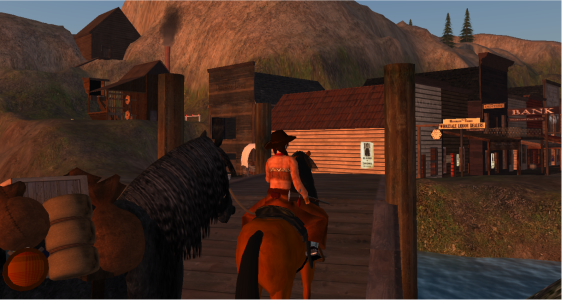
Showing posts with label virtual education. Show all posts

Sunday, October 10, 2010

That education thing in SL

~~~
Sooner or later I was going to need to write about the total goat screw on ice that is the current situation regarding the future of education and non-profit activity in Second Life. Most of you know that I have a great deal of enthusiasm for the various manifestations of learning that take place in SL, but I have never been impressed by the "Education" that goes on in-world. And I am not alone in that holding that point of view. For example, one of my academic friends who has been heavily involved in virtual educational projects--and wound up being extremely frustrated in the process--recently summed up her perspective on things with the statement "education in Second Life has not lived up to its potential."

She puts it so much more politely than I tend to, but I think we have a similar degree of dissatisfaction with the quality and outcomes we're seeing from many education projects in SL.

Nonetheless, I initially was somewhat disappointed when Linden lab made its recent announcement that they would be ending the 50% discount for education and non-profit customers. Even though I hold the personal opinion that the majority of educational projects in SL are mediocrities at best and dismal failures at worst, I still felt that it was important for the Labsters to continue to provide some kind of encouragement to people who are trying to use the platform for something more than pixel pokin'. Why? Well, mostly because I have really enjoyed learning things in Second Life, and I hope that other people will be open to the idea of making that happen. As my frustrated professor friend was pointing out, the educational potential of the platform is in fact immense and still largely unrealized.

Simply put, it didn't make a great deal of sense to me that LL had made this decision. I really hoped there was some kind of rational reasoning behind it...because that's just the kind of spit-dribbling, wild-eyed optimist that I am. So, I very much wanted to talk to someone about what had happened, but unfortunately, the people I used to talk to--such as Tom Hale and Claudia Linden--ain't around no more. By the way, if you will indulge me in going off on a tangent, I would like to state for the record right now that when I think about the fact that hard-working, intelligent people like Claudia have been let go, and a feckless, slack-jawed, incompetent like Wallace Linden is still there, I am utterly fucking gobsmacked. Do they somehow think that this brainless donkey turd of a wally has some special kind of understanding of how to communicate with the social user segment of SL's customer base, or is he simply blowing somebody in HR?

And please don't tell me that I might gain some insight into what is going on by looking at what the former Pathfinder Linden has to say. Totally aside from the fact that I have yet to meet any serious educator who actually derived any real practical benefit from trying to work with Pathfinder (please let me know if you have a verifiable example of something that would help me revise my view of that self absorbed, self-promoting douche), I can only conclude that Pathfinder was a naive simpleton who didn't realize that something like this was going to happen to the customers he brought in, OR he was aware and just conveniently neglected to mention that SL was likely to change it's policies towards educators. Consequently, I don't put much stock in his self-righteous pronouncements at this stage and wish he would just pretty much shut the fuck up.

But I digress.

The fact was, I hoped I could talk to someone and get a reasonable explanation from LL, but that wasn't going to happen. So all I can offer is some speculation based on what I have seen, especially now that Linden lab has kinda sorta backtracked and is going to phase out the discount over a little longer period of time.

Here's my thought: I wonder if the labsters had initially thought of the education/non-profit discount as a temporary incentive--get the teachy, feel-good folks in up front on the cheap so they could learn first-hand what the platform could be used for. It could also have been an opportunity for the creative educators to get something started that they could then show doubtful administrators, and be able to justify continuing their experiments.

Hey, if that was the case, I could really understand the whole thing. It would make sense to me. Plenty of companies give you an introductory rate to get you hooked on using their product: it is a standard rational type of business strategy. It's just that if this was what LL was doing, they didn't do a terribly good job of communicating about it with their customers, or their own staff people in certain areas for that matter. And they're still not communicating very well about it. But hey that's what they do--it's not like we should expect them to suddenly start doing communication right--not when they have a wally like Wally "managing conversations."

Ok...so let's assume that this was the strategy: get the educators in and doing cool stuff, and then eventually phase out the discount that encouraged them to start. Unfortunately, what happened was that the discount seems in many cases to have become something that enabled mediocre and failed projects to live on well beyond the point at which plugs should have been pulled. So maybe that's one of the silver linings in this particular ongoing chimp-and-weasel clusterfuck. People who should have looked at cutting back on their sim expenditures or moving to alternate grids long before this, will now be motivated to think more carefully about where they are going and what the hell they are doing. Plenty of very bright people have already made their moves (Heritage Key being one of the highest quality and possibly most successful examples)...

So boys and girls, now there's no excuse for other groups and institutions to not do the same. And yes, in many cases, when some of these institutions start asking themselves the hard question, the answer is going to be "screw it--the virtual world isn't ready for us and/or we're not ready for it." But that's not necessarily a bad thing. Sometimes the best thing you learn from an experiment is what doesn't work.

The ironic thing to me, as I reflected on this, was that this whole mess doesn't affect many great places in SL because the non-profit discount didn't apply to some of the best learning/teaching environments I have experienced in SL. Lots of places have done great stuff, but because the people putting the project together didn't happen to be associated with a school or have a 501(c)(3) letter from Uncle Sugar, they had to pay full price all along.

So does that mean that with the change in pricing, it is going to make things more of a level playing field for educational, informational and cultural projects regardless of who is behind the effort? No, it's just going to mean that life is going to be equally unfair. But--and I think this is the good part--it may also mean that schools and non-profits that do still see the potential in experimenting on SL will think really goddamn carefully about what they are doing, who will be doing it, and what outcomes they hope to achieve, before they move ahead or continue with a project.

While that is probably not the pay-off that LL was expecting or looking for with this pricing change, I think you can argue that it'll be a good thing if it does work out this way with fewer--but potentially better--education projects taking place on the platform. Hey, like Papaw used to say, even a blind squirrel finds a nut now and then.
~~~

Friday, April 16, 2010

Heritage Key -- a virtual world designed for learning

~~~
At Heritage Key, visiting Stonehenge as it was in ancient times


We know that learning takes place in virtual worlds. It isn’t always something that the designers of those worlds intended, and if they did intend for learning to happen it doesn’t always take place in the ways that designers hoped for or expected. Nonetheless, what we have seen happening--both in the unplanned learning that takes place and within the context of conscious educational experimentation--is giving some groups and individuals a sense of how they can try to do a better job of fostering structured learning experiences in virtual immersive environments. A wonderful example of this is Heritage Key, an independent learning grid utilizing OpenSim, software that is based on an open source version of Second Life code.

Heritage Key is a project of Rezzable, the company that is responsible for creative experiments such as the “Greenies” build in SL. However, rather than being a purely artistic or creative endeavor like the little green guys, Heritage Key is a stand-alone grid designed specifically for didactic purposes. Its elements include a number of archaeology/ancient history themed “exhibits” and immersion environments that are crafted to achieve specific learning goals, and to convey specific messages and information.

Elements of a structured learning experience in HK are distributed throughout the exhibits to provide context and meaning for the builds.


You come away from an experience in Heritage Key knowing something you didn’t know before, or having seen something you thought you were familiar with in a new light--and that information and perspective is more than likely one that the designers of the spaces wanted you to get.

This is real different from the type of learning I have been a part of and am familiar with in Second Life. There it’s not so much something that was intended, as it is a series of serendipitous light bulbs going on and someone suddenly saying “holy crap, I think we just learned something here, didn’t we?” It’s different and it’s intriguing. I have been visiting Heritage Key and watching their progress for a while. And yes, it is very much a work in progress. You can go visit it right now, but keep in mind it is changing almost daily.

Back when I started visiting HK, I was delighted to find that some old friends were part of the project: Viv Trafalgar and Jasper Kiergarten. They, along with some other folks who work there have been very friendly and forthcoming, answering my numerous questions. And when I hit them with some things they couldn’t answer, they directed me to Rezzable’s top guy, Jon Himoff.

Jon was likewise very helpful, especially as I was seeking to understand as well as possible the background of the project. Here are some of the questions I asked him, along with his answers:

DAK: I gather Rezzable Productions is a for-profit entity that generates income from advertising and providing services to facilitate virtual marketing initiatives for corporate clients (even the use of the term "sponsorships" implies an underwriting approach borrowed from the non-profit world). But I am unclear as to how Heritage Key is underwritten. I was wondering if perhaps it is actually not meant to generate income and is in fact a sort of "loss leader" designed to kill two birds with one well-crafted stone: doing something civic-minded and positive in terms of fostering learning in the metaverse; and actually creating a successful and innovative educational grid, thereby highlighting and promoting the creative and practical skills of Rezable and its partners?

In short, I'd really like to get a handle on why you're doing HK and what the goals are.”

Jon Himoff: (Our) goal is to make money with all this work on Rezzable/HK. We have equity funding to get all the technology and methodology in place. We started in 2007 really with the challenge of figuring out how to attract mainstream online users to more engaging, immersive experiences. Heritage key is our brand and we are using a combination of rich media--including virtual experiences to delivering unique, compelling content around the idea of traveling to ancient world sites. As this rolls out we are also looking at other types of brands that would benefit from real-time community capabilities. “

....Education is not as much an objective as making history relevant to people (or maybe that is what education should be?). Clearly if people find something intriguing or even fun then they will pull on it and drill into the material. The ancient world content fits the virtual online well--it has a level of imagination but also the facts are rich and many stories have not been told to large audiences (like Boudicca)."


DAK: “I would also like to know if there were there academic partners involved in each segment--content specialists who were partnered with the virtual worlds experts like Viv and Ordinal to create a successful and meaningful experience for the visitors? (I'm big on the idea of partnerships that cross boundaries of disciplines and worlds, and correct me if I'm wrong, but it seems like that must be part of your philosophy in trying to make your projects work)."

Jon Himoff: “The hard research comes from the experts. We are not subject matter experts, but the packagers of that into something engaging online. We actually spend a lot of time learning about the things we will make virtually -- in fact almost the entire content of the .com is the work in progress on that effort. We would like to work more with universities and museums. “

DAK: “I gather there is some connection between this open-sim grid version of King Tut and the VotK build, and a similar previous project on the SL platform (but that in moving to HK, the concept was refined and expanded). If I am correct in that, then I am curious why the use of SL was abandoned?”

Jon Himoff: "We use our own OpenSim-based grid. We did some initial work in SL, but it is too expensive and integration is impossible. SL will also not scale."

DAK: “I would also be curious to know how things that were learned in the course of developing and presenting the previous version may have shaped and facilitated the expansion and enhancement of the new version--and if so, what sorts of lessons were learned in the previous experiments?”

Jon Himoff: "I think major lesson has been that just because you build it, doesn't mean people will come. You need to do a lot of work to make things digestible for mainstream online users. Navigation is major issue. Also we are investing a lot of time/energy into offering quests as parts of dynamic, user-oriented story telling.”

DAK: “HK is obviously open for visitors, but still seems to be very much a work in progress--is there a schedule for opening additional elements and a plan for promoting usage of the HK grid as bugs get worked out?”

Jon Himoff: “Yes, it is a sort of open kitchen right now. We are also getting a lot of great feedback from visitors. There are some technical issues, but main focus is really getting the flow across the content working better. It is hard to get it all right--some people are newbies, others are gamers so their interest and skills are very different. Ultimately they should all gain something by visiting.”

DAK: “Is it accurate to say that the current exhibits you have set up on HK are not just a laboratory to work out how to get "the technology and the methodology in place," but they also essentially function as "demonstration" pieces, to show potential clients what can be accomplished with your platform and the good people you have working with you? “

Jon Himoff: “I think of it as a proof point -- it does work and it can scale. We have done Tut, Stonehenge and integrated rich web content as well. Check all the videos for example, but there are also tons of articles, images, slideshows. See site search results as an example http://heritage-key.com/search/ancientworld/king%20tut . I think you don't really know how something can work until you get on with it and try to make it engaging. You hit a lot of issues that you wouldn't see as critical until people are using it. “

DAK: “If the current exhibits are in fact demonstrators, I was also wondering if the upcoming British Museum segment is also a demonstration piece or an actual contract job for an institutional customer? ”

Jon Himoff: “The BM is not a customer, but I also don't really see the museums as customers. They should really be partners with us. In general we should be able to work with them to generate more interest in their collections and special exhibitions in order to drive more visits and make online more profitable for them. Especially for the sites--which often don't have strong collections but are very exciting to actually visit if you understand the context of the history.”

DAK: “In one of your answers to the previous questions you said that you gave up on doing projects in SL not just because of the cost, but because "Integration is impossible." Would you explain exactly what you mean by that?”

Jon Himoff: “Trying to create a streamlined user experience from web community to virtual experience is not possible in SL. There are no API's for example. There is no way to brand the viewer etc, etc etc. And I would add that Linden Labs is not a credible business partner. There model is selling virtual land (at a high price) in a closed, proprietary platform--so if that is all you want, then they have it ready for you. We don't see that as a foundation for 3D Web.”

I found Mr. Himoff’s answers enlightening...as well as raising other issues that I am still not clear on. The question of how they plan to monetize HK still eludes me a bit, although I have noted sponsors being associated with various elements such as the Steamfish game on the main Rezzable grid. I also understand British cab company Addison Lee is sponsoring an ancient London element of HK. But I am intrigued that they think of the institutions they are working with--such as the Britsih Museum--not as “customers” or clients, but as “partners.” I am curious about this knowing that there are other organizations that would have an interest in being involved with experiments like the exhibits on Heritage Key, and at this point I am not clear how they would go about exploring the possibilities with Rezzable--I suppose in the end I shall simply tell them to get in touch with Rezzable and see what they can work out, if anything.

So that’s all very cool, but I bet you’re wondering about what the experience itself is like--why am I so excited about this alternate grid.

Well for one thing, they don’t make you use Viewer 2.0, which, for the record, I completely and utterly loathe.

Instead HK uses a simplified version of the old SL viewer. One big difference, however, is that you cannot build here or create new objects. But you can fiddle about with some existing things--and that’s something I shall discuss momentarily.

So let’s start at the beginning: You go through a simple sign-up process and then you get to choose from a series of pre-made avatars (all with a distinct steampunk flavor as they were borrowed from or inspired by the steampunk look of the the educational “Steamfish” game that is on the primary Rezzable grid). You then go into a welcome area that includes basic instructions on how to walk, and teleporters that can take you to a travel center through which you access the various exhibits and environments.

The travel center, in the entry area.


The entry area is clean and attractive--suggestive of a temple/train station mash-up. At times, they have live helpers to assist new visitors. HK/Rezzable staff supervisor Angelina Rhode explained:

“It’s essential to be available to welcome people and show them around. Not everyone who visits the HK grid is an experienced user. I missed that in SL, not having someone guide you if you needed it, taking you by the hand and explaining how the basics of SL work. A virtual experience is something very different and new for many people and it’s important to have someone who can help you with your first steps, to show you where to customize your avatar and then explain how to get to all the exhibitions. Of course we have many signs which do that too, but to talk with someone feels better and you can ask questions the signs probably cant answer.”

I like that a lot -- the idea that there will be times when live people will be there. Yes, if you are used to working with SL, Heritage Key will be second nature for you. But the visitor who is new to virtual worlds has the possibility of getting help from a real person.

There are also tutorial areas where you can make changes to your avatar, get new hair and outfits and learn more about how to navigate, communicate, interact with objects etc. All the usual stuff you get in orientation areas of SL, but cleaner-looking, easier to follow, and devoid of griefing morons.

Tutorial area where various functional skills are taught.


Being the busybody that I am, I quickly found that even if you can’t make your own stuff in HK, you can manipulate most of the hair and outfits to suit individual taste and mix and match. There are also outfits and hair that can be obtained in some of the exhibits. For example, when I got to the “Life on the Nile” environment, I took a man’s tunic and stretched it into a dress, redid the armlets as bracelets to fit me, and then shortened the long hair I picked up in the avatar center. Later on, I got another set of beaded hair from one of the mini-games in that build.

Sitting at the cosmetics table in the scribe's house, where I got my new hair with beads and all. An informative primatar is located in this room (as is the case with many rooms of the compound) to provide interpretive information. The primatars throughout the build were created by the highly skilled Jasper Kiergarten.


So then you go on to the various exhibits and environments. These include, so far, an exhibition of artifacts from King Tut’s tomb, an immersion environment recreating the Valley of the Kings at the time of Howard Carter’s excavations in the 1920s, a series of recreations of Stonehenge (showing how it developed and changed over time, from its initial stages up to the present), and a “Life on the Nile” environment that represents an affluent scribe’s household in Amarna, circa 1350 BCE.

In the Tut exhibit, viewing a the three dimensional, 360 degree recreations of one of the inner coffins. Clicking on various exhibit elements brings up interpretive information about the object, as well as links to additional interpretive materials.


I liked all the elements. The 360 degree representations of the artifacts in the Tut exhibit are just mind-buggering awesome. They can be viewed both in relative scale so you get a sense of their actual size in real life, and as “blow-ups” so you can see the stunning detail. The Valley of the Kings environment can be viewed either just as a cool immersion experience, or you can take advantage of various game-like elements that allow you to “follow in the footsteps” of Howard Carter.

I especially liked the recreation of the tomb, which for the first time gave me a clear idea of how it was laid out and just how bloody cramped the damn thing actually was.

Inside King Tut's tomb. The sarcophagus has theoretically been "removed" so it is represented by a semi-transparent place holder object.


The Stonehenge experience was engaging and attractively done. This is what a virtual space is ideal for: allowing you to move around in a space, see it from different angles, interact with objects, carry out tasks (and get easter eggs in the process) and most of all to see change over time.

Stonehenge, the present day.

At first I wasn't real keen on trying out the various mini-games and "scavenger hunt" kinds of activities. Keep in mind that I'm a terrible museum goer. I never follow the path the designers intended for me; I generally skip reading labels; I don't like feeling managed or manipulated. But Viv kept encouraging me to try some of these elements in Amarna, and soon I found myself getting caught up in them, especially once my competitive instincts kicked in.


One of the simple mini-games scattered through the various exhibits--this one, located in the scribe's house, gives you a mask of the river god as a prize when you get the answers correct.


Of all the areas in Heritage key, my favorite, not surprisingly, is the Amarna build. A number of the HK exhibits had been done before in some form in SL, including Valley of the Kings and Amarna (the Stonehenge one is, I believe, completely new). but they were completely redone by a team that included Viv Trafalgar, Jasper Kiergarten, Ianthe Farshore, My Mackenzie, Pavig Lok and LT Bartlett.

Interacting with a primatar at the scribe's house. He asks you questions to make sure you "belong" there. If you can't answer, you apparently get dumped in the pond.

These folks did a superb job. Just to give you an idea of the kinds of people who worked on these projects, I would like to share with you a bit about Viv's background: she has taught at both the high school level (poetry, literature, and writing) and at the university level (hypermedia design, Flash, web design, etc.). She comes from a programming and a graphic design/writing background, and has an MFA in poetry and MA in Interaction Design and Publications Design.

As an educator and virtual artist, Viv made the following comment about HK:

“I love creating spaces where there's a lot of potential for imagination to play, but there's also a lot of learning potential...and I am in love with this platform because it is more open and new-developer friendly than some of the platforms I've worked on.”

In the immersion environment of the Valley of the Kings, 1920s,


OK, so it’s great, but is it perfect?

No of course not. Nothing is perfect. Especially something like this that is still a work in progress. For example, it usually takes me three or four tries to get logged on. Sometimes funny things happen with what I am wearing. Viv recently told me that periodically all the builders find that OpenSim has hidden all their inventory. As she says. “it’s still very beta...depending on what viewer you use it's got different ways of behaving...and then on the third Saturday of the full moon at 2pm it just decides to go down the pub for a few...it's a bit like working with a cranky, but talented toddler.”

On the other hand it has been consistently improving. Viv further pointed out that, “A year and a half ago, the first opensim tests I went on--you couldn't have more than 8 people not moving or doing anything on the grid. Now? So much is possible...it's a huge growth and change rate.”

And not only is it technically improving, but the Rezzable people are taking a direct hand in making it work better for the audience. Yes...that's right: if you give them feedback they will actually listen. One of the things I passed on after my first visit was that I longed to be rid of the dreaded default “duck walk” and desperately wanted an AO. I was told that other people had mentioned it and they were working on it. Lo and behold, when I signed on today there was a gizmo both in the entry area and the Avatar Center distributing a free AO. Admittedly, it's not the best one I’ve ever seen (and slightly glitchy as it was in alpha), but it sure as hell beat the snot out of waddling around and feeling that compulsion to quack.

Are there other things that I don’t like about HK?

Well to be honest, there are some things that I wish had been done differently. I think the inclusion of multiple OOC signs, the steampunky-looking teleporters, and other OOC bits and bobs in the immersion environments does detract slightly from the overall effect of the experience. But at the same time, these elements are important for the “mini-game” and didactic aspects of the builds. I guess it‘s mostly a question of esthetics, and it’s certainly more important that the visitors actually see the pieces that they have to interact with in order to benefit from all the learning opportunities. If these features weren't as visible as they are, a lot of visitors would probably miss them altogether. Also, the freebie Egyptian women’s dresses were a little too fancy for my tastes, and I thought they looked a bit more Hellenic than Egyptian. But that’s just me being a persnickety old harpy. Minor stuff.

From certain viewpoints, the immersion effect is disrupted by the logistical and didactic elements, but they have to be somewhere, right?


The big picture is that I think this works. It offers that kind of improv theater/Kon Tiki/hands-on immersion learning experience that you hope for in a virtual world: it's essentially, as we say, "socially interactive self directed learning" reinforced through play--but in HK they have actually managed to utilize that dynamic combined with the kind of structured goals and desired outcomes that usually don’t seem workable on a platform like SL.

On a big reed boat on the Nile.


Yes, in SL we can have those self directed learning experiences--especially as they relate to world building and the skills connected with content creation, which you can’t do in a place like Heritage Key. But in HK, they have managed to integrate a form of that “exploration” experience with the communication of very specific messages designed by the educators and experts. And every time I go there, something new is underway, and its functionality keeps improving. I think Heritage Key represents an important step in the evolution of virtual worlds as a place to learn and teach.
~~~

Friday, March 12, 2010

Comings and Goings at the Lab -- Claudia takes over from Pathfinder

~~~
In light of the recent elimination of Pathfinder’s position with Linden Lab, a great many residents with an interest in education have expressed the fear that LL is moving away from promotion of the platform as a tool for educational purposes.

To some extent, this is understandable--but to be honest, as far as I can tell, the departure really means nothing more than a particular person who seemed to be an advocate of education in SL just won’t be around any more. People come and go. It's just time for Pathfinder to continue his life's journey elsewhere, and I hope he does well in his next gig.

That said, I should also point out that I never had any contact with Pathfinder (John Lester irl), because like many Lindens, he was simply irrelevant in the course of my activities on SL.

To be honest, I was never entirely clear on what Pathfinder’s real role was--at various points in his time at the Lab, I was led to understand that his title was something like “Evangelist, Market Development.” Although education was clearly one of his concerns, there were always indications that his role was to promote the general idea of Second Life (the evangelism bit) and to develop a marketing strategy that would seek to attract not just educational institutions to the platform, but also other types of potential corporate and institutional customers. Even as he was leaving LL, Pathfinder stated that he had been involved with healthcare as well as education customers.

So did he really make a big difference to education on the grid? Maybe he did. I have been told that he was responsible for bringing in some very large institutions of higher learning to SL. But again, being totally honest, I can’t really say for sure what his impact was. All I know is that I have talked with some educators who actually did have contact with him, and they did not find him to be particularly helpful or pleasant to work with. I am sure there are others who did in fact find dealing with Mr. Lester to be a useful and positive experience--but I just haven’t come across any of them yet.

But as they say at Swamp castle, "let's not quibble about 'oo killed 'oo."

The larger question, of course, is what comes next.

Many people seem to be assuming that the Lab won’t do anything to fill Pathfinder's role--that they eliminated his job, and therefore have eliminated the idea of having anyone addressing the interests of educational customers. I was wondering about this myself, as the Lab made no announcement about it that I could find. I decided to take advantage of the fact that T Linden (Tom Hale, LL’s Chief Product Officer) had recently added a comment to an older post on Miss Emilly Orr’s blog, in which he offered to answer other questions “off-thread.” Being the presumptuous old harpy that I am, I decided he obviously addressed this not only to Emilly, but to the rest of us who had commented on the thread, and I sent him a message asking if I could run some questions past him.

Mr. Hale graciously agreed to do so, and some of the things I asked him to comment about were questions related the departure of Pathfinder. He replied that while “we can't really discuss the departure of employees,” he was able to tell me the following:

“Claudia Linden is taking on Pathfinder's responsibilities, and she's been a strong and capable advocate for Education and Educational institutions in Second Life.”

Of course, as "head of educational support" (I apologize that I am unsure of what her exact title is, but I have seen her described thusly), Claudia was already substantially engaged with educators on the grid. So whatever it was that Pathfinder did is being added to what she already does. And clearly it's an ongoing process--today Claudia launched the first iteration of a directory of educational institutions in Second Life, which can be found here.

So I was gratified to see that she's as busy as ever. Now mind you, I’m going to be watching this particular project, because this directory thing was a pretty straightforward and focused single step: it seems to be structured as a simple directory of institutions of higher learning on the grid. I will be very curious to see what gets done in the future to promote and support the activities of individual educators and theorists, as well as non-traditional educational groups that are developing the most innovative and interesting learning opportunities on the platform.

Still, I was really freakin’ happy to hear from T that somebody had in fact been given the job of looking after whatever aspects of education that Pathfinder was looking after. I think it was a really important step to hear this from the proverbial horse's mouth.

I know I can be awful hard on the labsters sometimes. But like I have said before, I really try to be as fair as I can--I try to give credit where it is due. Hell, I was tickled just to see a Linden commenting on Emilly’s blog, which which must feel a bit like hostile territory for them. I have to admit, boys and girls, sometimes I feel like I’m a foam-at-the-mouth fanboy compared to Miss Orr. She's brilliant and hard and passionate, and so I thought it was brave--and damned smart--of T to not just be reading her stuff, but also to comment and to offer to chat further.

I keep hammering at this, but I think it is true more than ever that as the platform continues to evolve, the Lindens need to come out of the ivory tower to see and be seen in more venues and more discussions. Office hours are fine, but they have to visit more of the odd crevasses and backwaters of the grid and have more informal conversations with those of their current customers who have the perception that the Lab is not interested in them. In times of uncertainty and change, a company has to step up its efforts to communicate with their customers--and not just the highly vocal minority they usually interact with. It has to be demonstrated that they are going the extra mile to make a sincere effort to understand what we want and what we need. Things like T commenting on Emilly's blog certainly qualify as just that.

In sum, this is another of those occasions when--being the wild-eyed, spit-dribbling optimist that I am--I am seeing some things to be encouraged about.

And I wish Claudia well with her continuing efforts to support and encourage Education on the grid.
~~~

Sunday, March 7, 2010

Still pondering this one -- learning and "education" in SL, cont.

~~~
Well the title pretty much says it all: I'm still struggling with this, I'm still talking to very bright and thoughtful people who are trying teach in SL and who are trying to understand how educators can successfully use the platform to teach and to facilitate and encourage learning....and I still don't have some Big Answer that will smack you over the head the rubber chicken of profundity and squeeze you in the appallingly enthusiastic bear-hug of irrefutable truth. The best I can give you right now is that people are still experimenting and still trying to understand what will consistently work as an approach to education in SL. And I think what they are trying to figure out is really important.

Now, there does seem to be some consensus among the people I talk to about this subject as to what doesn't work very well. As we have discussed previously, there is pretty consistent agreement that if a teacher or an institution tries to just transplant what they do in the bricks and mortar world to a virtual world, the results are going to be mediocre at best.

For example I had the following conversation with John Carter McKnight, an adjunct professor of Law at Arizona State University, who brings students from into WoW and SL for learning experiences:

Diogenes Kuhr: what we are talking about..what you do with a guild in Wow, and what you could do with a roleplay town in SL...
Diogenes Kuhr: it's real different from what you can and will do with a class in organic space
JCM: yes
Diogenes Kuhr: so is this another indication that it is in fact true that one of the things that tends to not work well here is to try to just transfer your meatspace methodology and approach to the virtual?
JCM: yes yes yes
JCM: this is not a good medium for talking heads lectures, and worse for seminar discussion - though viewer 2.0 is a huge leap forward

I frankly have big issues with colleges and universities that come into a world like SL and simply build a virtual recreation of their campus and square box classrooms. And it's the same issues I have with museums that come in and try to recreate exhibits and environments that are structurally and didactically analogous to what they do in the real world. But why don't these traditional approaches to instructional design work terribly well in virtual spaces? I recently went to one of the big university virtual campuses in SL, just to have a look around, and what I found was what I find on museum spaces that don't work either: an empty, uninteresting, sterile environment, devoid of excitement, devoid of life...and largely devoid of other people.

In fact, on this campus I visited, I ran into a lone student, who asked me if I was associated with the school. Her confusion was understandable, because silly old me--I had inadvertently neglected to remove my "professor" tag from the Hogwarts United rp sim. But it turned out to be a happy accident, as the combination of my having the tag and being on the campus of the school gave her the confidence to approach me and to say hello. It seems that the school had pretty much brought students in, given them a minimal bit of mentoring, and then turned them loose to "explore" SL on their own. It was essentially sink or swim, and this student had not reached a comfort level that enabled her to venture forth into the wilds of SL--which also wasn't surprising being as she had heard horror stories from other students about entering SL though the regualr noobie portals and suffering various abuse and indignities (she had been brought in and started at the school's virtual campus, and so had been spared that unhappy experience).

So I spent some time, explaining a few things, and took her out to visit different places of interest--I told her about places like Caledon and Deadwood, and all the various steampunk communities, and helped her sort out a few of the tricks you need to know to make SL look better and run better....and by golly within a week, this gal had just blossomed! She was traveling around on her own, had got a cottage and furnished it, had some great Victorian clothing, and even came and did some rp me with in Deadwood!

It doesn't take much, when you're mentoring someone who isn't an idiot. So why don't the big edusaurians put more effort into organizing some mentoring arrangements with people who really know how to enjoy and utilize the platform? Technology does not replace the human element in education. It does not even make things easier or more convenient for the educators. Sweet Jeezus and his fuzzy lil' donkey, boys, if you bring students in here, you have a responsibility to foster and facilitate--don't just turn 'em loose and let natural selection take its course.

There is another good reason for doing this--as Dr. Suzanne Aurilio has pointed out, there is an exciting dynamic in learning in SL--a dynamic that she witnessed when she did the study for her dissertation. The successful learning that we see happening--and it's not just Suzanne seeing it , but it's what I see in places like Deadwood--involves a fascinating sort of socially interactive self-directed learning that occurs in a collective, mutually supportive context.

In short, what we have seen work well on the grid so far are examples of people learning as they motivate and encourage one another, help others deal with the unique social and technological aspects of life in-world, and have others to help them when they get stuck.

That does however, bring up a problem that John and I also discussed. If the most successful learning on the grid seems to happen primarily in the context of socially interactive, informal circumstances, then what about traditional students--the ones who come to SL within an institutional context, and who for the most part range in age from their late teens to early 20s?

The issue of age may be signficant: after all, the learners in Dr. Aurilio's study were older women; the youngest people I have successfully engaged with in learning situations in Caledon and Deadwood are in their 30s; and the nice gal I helped to be able to leave the big empty virtual campus? Also an older student. So is SL simply something that isn't going to work well for the usual student demographic? Some educators would argue that it hasn't so far.

John proposed an interesting explanation for this:

JCM: it seems a lot of 20-somethings, especially those in school, don't see SL filling any need for them
JCM: they socialize constantly already
JCM: they're on campus, so getting more than their fill of talks and events
JCM: so, no real point for them
Diogenes Kuhr: that makes sense..
JCM: yeah, basically SL re-creates for the rest of us what they have already - youth, health, fun, adventure, intellectual enrichment :p

So does that mean educators should give up and just keep focusing on older learners in mutually supportive, socially interactive (yet still largely informal) arrangements? Should the colleges and universties jsut de-rez their virtual campuses and go back to meatspace?

No. Hell No. Things are just now starting to get interesting.

There are some really smart people trying to figure out how to take what they are learning from those older nontraditional, mutually supportive, self directed learners, and to apply that in designing systems and structures that will enable educators to foster a more positive, consistent learning experience for their traditional students.

Well I had said I wasn't gonna smack you with the rubber chicken of profundity, so let me just sit you down on the whoopee cushion of opinion:

I think the schools in SL probably should go ahead and de-rez those big prim ivory towers with their ivy-walled textures...but then not abandon the space. Keep the space and start experimenting. They need to try new experiments like Dr. Aurilio is pursuing with her students from San Diego State, and they need to be prepared to think really damned carefully about what they are trying to accomplish, and then examine the results to see what actually happened and why. Dr. Aurilio put it this way to me:

SA: I will tell you this....
SA: On our initiative website, you'll see "educational outcomes" and when I finish it, an assessment/evaluation plan
SA: and from them I should be able to make some legitimate claims about the initiative's impact.

And as John says, these virtual education spaces need "small group orientation, and a lot of it."

And what about Linden lab? What can they do to facilitate this process of experimentation, of honest assessment, and ultimately, educational innovation?

I think the Lab needs to stop trying to just make money off educators by simply trying to sell them classrooms in a box. The Lab should encourage schools to think about how they can actually utilize the platform for new approaches to learning. And LL should encourage academics to look upon the grid's diverse communties and resdients as potential partners--not just as curiosities to be "studied."

And for Chirssakes, they need to do something about the grieftards who make the initial experience for newcomers such an unpleasant mess. They should put staff at the noobie portals to stand guard....send in ringers posing as noobs, and when they get harassed, kill and ban the smarmy little pencildicks who are the perps. Nobody is going to learn well in an environment that comes across as hostile from the get-go. So LL must clean that up. It's bad for learning, and by gawd, it's bad for business.

But hell, that's just my opinion.
~~~

Tuesday, February 16, 2010

Learning and “Education” in Second Life -- are they two very different things?

~~~
The San Jose State University build: one of many higher ed campuses in SL

I’ve been meaning to write about this for some time: the idea that SL offers opportunities for more than commerce, marketing and socializing--it is a place where a great deal of learning takes place. The curious fact of it, however, seems to be that while there may be substantial learning going on, it is not necessarily the result of teaching in the way that we usually think of it.

So I’ve been pondering on this and have had some conversations with other people who have an interest in the subject of learning in SL. Among those with whom I have had some of the most interesting and intelligent conversations are Aurili Oh, (in real life, Dr. Suzanne Aurilio of San Diego State University who has done her Ph.D. dissertation on learning in sl) and Serenek Timeless (also a real life academic, who is involved with the Renaissance Island sim). However, I hadn’t written about it yet, in part because I’m tired and my brain hurts a lot these days, but also because I still have the sense that I don’t understand a great deal about why certain things seem to happen with learning in SL, and other things just bloody well don’t.

Obviously, I’m not the only one trying to figure it out, and what finally got me inspired to start my part of the public conversation about it was two recent pieces that have appeared on the inter-tubes:

One is this recent article by Jeffrey Young on the Chronicle of Higher Education’s web site, entitled, “After Frustrations in Second Life, Colleges Look to New Virtual Worlds.” Mr. Young ‘s actual article is a slightly more-intelligent-than-usual variation on the current “SL is dead” meme, framed within the context of virtual education. He points to a number of academic institutions that are scaling back on their presence in SL and briefly discusses some of the alternatives.

The other piece that provided an intriguing counterpoint to the CoHE article was a post about the results of a survey conducted by the New Media Consortium, which reported that not only has interest in virtual worlds in general remained high among educators, but that Second Life is still the primary virtual world platform utilized by educators (76% of the respondents said it was what they predominantly used). You really ought to go take a look at the survey results--it’s fun stuff, especially the tidbits about why some universities and colleges staunchly resist the siren call of virtual worlds. But it does also somewhat contradict Mr. Young’s contentions, which after all do seem to be primarily based upon anecdotal evidence and his own limited experience, rather than any kind of actual data such as the NMC tried to present with its survey.

That said, I think you can argue that Mr. Young’s piece does reflect a certain reality: that some of the big schools that got involved with SL apparently are now arriving at the same conclusion that many big businesses on the grid came to over the course of the last several years. Like many large corporate residents of SL, schools are perhaps finding that the platform did not live up to their expectations (or the hype). What is really interesting about the CoHE article however, is the comments. I recommend that you sort through them, in a particular because they shed some light on why some universities and colleges may be coming to this conclusion.

Let me give you a sampling of how people responded to Mr. Young. One correspondent, under the handle “alex_heiphetz,” commented:

“It has become apparent a while ago that building copies of university campuses in Second Life does not produce any results and can only kill an interest in the new technology. To me it is also clear those who begin with building campuses, and do not progress towards using interactive and collaborative opportunities of virtual world are often the people who complain about lack of control, lack of security, etc; while those of us who work with more advanced projects find our way with security, griefers and control. This is not to say that Second Life is absolutely the best forever and ever, but to say that it does work well today, especially where education and training benefit from interactivity, 3D visuals and collaborative knowledge management/transfer.”

I think Alex hit one of the nails pretty squarely on the head. As we have seen with businesses --and as I have pointed out time and again with museums in SL--you can’t come in to a space like Second Life and succeed by simply building a pixelated version of your real life facility and trying to connect and communicate with your audience in the same ways that you do in meatspace. If it’s going to work, it’s going to do so because you’re taking advantage of the unique environment and the tools, and doing something completely different. When it succeeds, it's becuase you're using the platform in ways that enable you to try things that you really can’t accomplish effectively (or at reasonable cost) in a bricks and mortar space.

Another well considered response came from the always thoughtful John Carter McKnight:

“I am currently teaching a law school course at Arizona State University on the governance of virtual worlds, with sessions in the classroom, in World Of Warcraft and Second Life. Virtual worlds provide an opportunity for hands-on engagement with community building, with contract, property and criminal law.

Yes, it takes time to learn the medium. It takes time to learn the medium of law school as well. 


Yes, there are colorful people and environments in SL: there are in the neighborhood around our campus as well. Teaching, whether in the physical or digital classroom, is embedded in a larger community. Few of us study in remote monasteries anymore. This is not a bug, but a feature. 


Second Life enables us to bring guest speakers from around the world into our classroom, at no cost. It also enables my students to experience the legal and political issues around online communities first hand, rather than as dry abstractions.”


So John gets it--in essence he’s saying that part of what makes his classes in SL work are some of the very same considerations that other academics look on as drawbacks or “frustrations.” I love that line--”This is not a bug, but a feature.” Damn, I want to put that on a coffee mug AND a T-shirt.

The interesting thing here is that people like Mr. McKnight seem to be finding new ways to teach using a platform like Second Life. This is what intrigues me: “Education” (with a capital “E”)--the business of education as we know it in the real world--doesn’t seem to necessarily work very well in a virtual world like Second Life. People do seem to be finding ways to learn AND to teach on the grid, but not in a tradtional "formal" way.

This is essentially at the heart of Dr. Aurilio’s findings which she put forth in her dissertation--that “formal” education in SL usually doesn’t work terribly well. But what does work remarkably often (and remarkably well) are various manifestations of self-directed learning, some of which take place within an individual context, while other examples are carried out in a collaborative (or at least mutually supportive) collective environment.

Dr. Aurilio studied learning among adults on the platform and came to some wonderful conclusions including:

* Learning is technologically and socially platform-specific.

* It is socially interdependent.


* It depends on intrinsically motivating activities.


* It engenders forms of learning-by-doing.


I was also struck in the course of talking with her that my view of places like Renaissance Island and Deadwood being most successful as venues for self-directed learning needs to be considered in a different way than I have been thinking of it in the past. The fact is, even when you are motivating yourself to learn something--how to build a world or a chair, what forms of material culture were used in a particular time and place you are trying to recreate, the social history of an era that is going to be represented in roleplaying, etc.--you are not doing so in isolation.

When learning has happened among us in the Deadwood community, it is a wonderfully collective experience. We share research, we make things for each other, we share ideas and develop collective goals...we also egg each other on, we encourage each other and at times we challenge each other. Clay Kungler, for example, has been teaching himself (learning by doing) to build and script things, and he asks me, “Hey Boss, what do we need for our 1870s placer mining operation that we don’t have?” And I say, “Well, Bubba, we sure could use some wheelbarrows and these things called rockers that you use for sifting gravel and sand.” And then he says, “So what’s a rocker look like and how does it work?” And I do the research and find cool pictures to send him. Then he says, “So what does an 1870s wheelbarrow look like?” And I say, “Shit, I don’t know, I’ll work on it.” And I do more research and find some pictures and learn that the guy who made Studebaker wagons (and later on, Studebaker cars) started out making wheelbarrows in the gold fields of California. Meanwhile Clay is figuring out not just how he’s going to make this junk look right, but how he’s going to script it to work as dynamic adjuncts to the rp storyline. Finally, these things are going to be shared with other people in the sim, and they will be learning about the historic processes of placer mining while playing with the objects that I researched and Clay built.

So is it self-directed learning? Yes and no. As Dr. Aurilio said to me about her observations of learning in SL:

“...it fundamentally involves others, in terms of sharing, asking for help, using the resources others have created and creating them for others too. My participants also seemed to be motivated to learn by what other Residents built. Several commented that when they saw things other Residents had made, they felt inspired to try and make it themselves. I’m re-thinking the notion of “self-directedness”. What exactly does that look like in an environment such as SL, or the Web for that matter?”

And how does this all apply to issues of teaching in Second Life? In this context of self-directed learning in a collaborative environment, what is the role of the teacher? Do you become more of a community leader than a “teacher” in the traditional sense?

Ultimately, I do believe in the future of virtual worlds as a vital and vibrant learning environment. But I suspect the most successful manifestations of it will not be developing in the arena of “mass-production” education. And to try to make it work as such arguably is a dreadful waste of the potential that virtual worlds hold.
~~~

Saturday, September 12, 2009

Visiting a literary experiment -- Virtual Macbeth

~~~
Addison and I visit the Macbeth sim.

You know how I am continually fascinated by the experiments that people try out in SL. If it's a different, I'll go look at it. So not surprisingly I got excited when Addison Leigh, a friend from Deadwood, recently told me about the build in the Virtual Macbeth sim, called "Foul Whisperings, Strange Matters - A Second Life Treatment of Macbeth." Tonight she took me to see it, and we had a great time.

According to the project website:

"Virtual Macbeth is an island in Second Life which is dedicated to the exploration, adaptation and performance of Shakespeare's Macbeth. The island was designed by Angela Thomas (virtual worlds content designer), Kerreen Ely-Harper (director) and Kate Richards (producer). Funding was provided by Literature Board of The Australian Council for the Arts , and investor partner, the New Media Consortium.

The island is designed with target audiences of Shakespeare afficionados, Secondary and Tertiary educators and their students."


So we went, and it took us a while to get the hang of navigating it (which is part of its appeal, I think--you're not going to get this build if you're a dry-humping moron). But once you do get it, and understand how to navigate and you find all the helpful directions and explanations on the wiki that you are given a link to, it's a fascinating exploration of abstract concepts and themes that are key to understanding and enjoying the play.

It's not what I was expecting, which would have been straightforward recreations of scenes and settings from the play. Instead, it was a tour of the inside of Macbeth's head (literally and figuratively) and the different elements of the build trace his journey into madness and ultimately, his destruction. There are choices to make, different paths to follow, and various surrealist manifestations of abstract ideas, such as a maze, ruins, and a "chamber of blood" in which you take on the the part of the increasingly mad king, striking out at anyone who threatens your power (provided you put on the attachment gizmo you were supposed to pick up from the fountain in the entry area).

Here are Addison and I, lashing out at the apparitions in this particular environment:


There is a throne room environment, but it is not meant as a literal representation of a medieval throne room: it is meant to represent "Macbeth's ego" according to the guide on the wiki, and includes various interactive features and ghosts and a heapin' helpin' of symbolism. It's really fun stuff--very engaging, and you can spend quite a while exploring and figuring things out, and trying different elements of the build. I truly recommend that if you choose to make a visit, you do so with a friend (preferably someone who like yourself, is not a dry-humping moron) so you can enjoy discovering the little surprises of the build together, discussing what this or that thing might mean or represent, and every now and then helping each other out with a shove or a well-timed tp when you get stuck or befuddled (there was point in the maze where I was wishing I had just a teensy bit of C4 to expedite making an exit--though I did get it figured out eventually).

Stylistically the look of the sim is very Bayreuth Opera, 1953: lots of German expressionst and surrealist vocabulary, which I found kind of fun. After all, Shakespeare is, in many ways, very operatic in scope and subject matter, so I thought it fit. And although the notecard instructions at the beginning tell you to keep the environment settings on default (which is night time), if you go ahead and put it on sunset, you get a pretty spectacular effect that enhances the surreal affect of the build.


Parts of the build are actually downright gorgeous in sunset lighting--it really reminds me of stuff my uncle did after WWII when he went to art school on the GI Bill: warm lighting washing over ruins and wind swept landscapes, expressing just a touch of melancholy with maybe a little PTSD thrown in for good measure.

So yes, if you're not an idiot, you probably want to go check this out if you haven't already. And, yeah, I know, it apparently has been up since late last year, but hey, I freely admit that I live most of my life under a freakin' rock, OK?

And if maybe you're going "hey, this is old news..." What can I say? Sorry I didn't tell you about this sooner, but I get around only a little at a time in my travels. So sue me.

Seriously, despite some confusing moments (some of which may have been the result of some of the AV stuff or other bits possibly being borked by SL), I think it's worth a visit and spending some time. Addi and I enjoyed ourselves, and we spent a good hour or so looking around and playing with many of the elements. A lot of thought and effort went into this particular experiment, and I could see it inspiring some other interesting stuff in the future.
~~~