Showing posts with label Suzanne Aurilio. Show all posts

Sunday, March 7, 2010

Still pondering this one -- learning and "education" in SL, cont.

~~~
Well the title pretty much says it all: I'm still struggling with this, I'm still talking to very bright and thoughtful people who are trying teach in SL and who are trying to understand how educators can successfully use the platform to teach and to facilitate and encourage learning....and I still don't have some Big Answer that will smack you over the head the rubber chicken of profundity and squeeze you in the appallingly enthusiastic bear-hug of irrefutable truth. The best I can give you right now is that people are still experimenting and still trying to understand what will consistently work as an approach to education in SL. And I think what they are trying to figure out is really important.

Now, there does seem to be some consensus among the people I talk to about this subject as to what doesn't work very well. As we have discussed previously, there is pretty consistent agreement that if a teacher or an institution tries to just transplant what they do in the bricks and mortar world to a virtual world, the results are going to be mediocre at best.

For example I had the following conversation with John Carter McKnight, an adjunct professor of Law at Arizona State University, who brings students from into WoW and SL for learning experiences:

Diogenes Kuhr: what we are talking about..what you do with a guild in Wow, and what you could do with a roleplay town in SL...
Diogenes Kuhr: it's real different from what you can and will do with a class in organic space
JCM: yes
Diogenes Kuhr: so is this another indication that it is in fact true that one of the things that tends to not work well here is to try to just transfer your meatspace methodology and approach to the virtual?
JCM: yes yes yes
JCM: this is not a good medium for talking heads lectures, and worse for seminar discussion - though viewer 2.0 is a huge leap forward

I frankly have big issues with colleges and universities that come into a world like SL and simply build a virtual recreation of their campus and square box classrooms. And it's the same issues I have with museums that come in and try to recreate exhibits and environments that are structurally and didactically analogous to what they do in the real world. But why don't these traditional approaches to instructional design work terribly well in virtual spaces? I recently went to one of the big university virtual campuses in SL, just to have a look around, and what I found was what I find on museum spaces that don't work either: an empty, uninteresting, sterile environment, devoid of excitement, devoid of life...and largely devoid of other people.

In fact, on this campus I visited, I ran into a lone student, who asked me if I was associated with the school. Her confusion was understandable, because silly old me--I had inadvertently neglected to remove my "professor" tag from the Hogwarts United rp sim. But it turned out to be a happy accident, as the combination of my having the tag and being on the campus of the school gave her the confidence to approach me and to say hello. It seems that the school had pretty much brought students in, given them a minimal bit of mentoring, and then turned them loose to "explore" SL on their own. It was essentially sink or swim, and this student had not reached a comfort level that enabled her to venture forth into the wilds of SL--which also wasn't surprising being as she had heard horror stories from other students about entering SL though the regualr noobie portals and suffering various abuse and indignities (she had been brought in and started at the school's virtual campus, and so had been spared that unhappy experience).

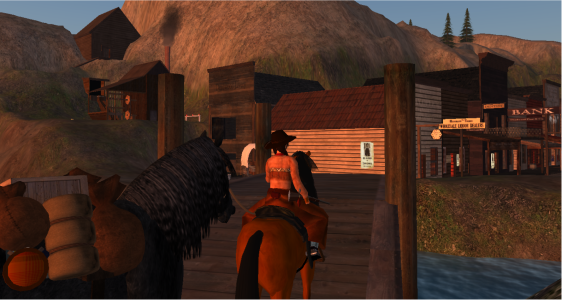
So I spent some time, explaining a few things, and took her out to visit different places of interest--I told her about places like Caledon and Deadwood, and all the various steampunk communities, and helped her sort out a few of the tricks you need to know to make SL look better and run better....and by golly within a week, this gal had just blossomed! She was traveling around on her own, had got a cottage and furnished it, had some great Victorian clothing, and even came and did some rp me with in Deadwood!

It doesn't take much, when you're mentoring someone who isn't an idiot. So why don't the big edusaurians put more effort into organizing some mentoring arrangements with people who really know how to enjoy and utilize the platform? Technology does not replace the human element in education. It does not even make things easier or more convenient for the educators. Sweet Jeezus and his fuzzy lil' donkey, boys, if you bring students in here, you have a responsibility to foster and facilitate--don't just turn 'em loose and let natural selection take its course.

There is another good reason for doing this--as Dr. Suzanne Aurilio has pointed out, there is an exciting dynamic in learning in SL--a dynamic that she witnessed when she did the study for her dissertation. The successful learning that we see happening--and it's not just Suzanne seeing it , but it's what I see in places like Deadwood--involves a fascinating sort of socially interactive self-directed learning that occurs in a collective, mutually supportive context.

In short, what we have seen work well on the grid so far are examples of people learning as they motivate and encourage one another, help others deal with the unique social and technological aspects of life in-world, and have others to help them when they get stuck.

That does however, bring up a problem that John and I also discussed. If the most successful learning on the grid seems to happen primarily in the context of socially interactive, informal circumstances, then what about traditional students--the ones who come to SL within an institutional context, and who for the most part range in age from their late teens to early 20s?

The issue of age may be signficant: after all, the learners in Dr. Aurilio's study were older women; the youngest people I have successfully engaged with in learning situations in Caledon and Deadwood are in their 30s; and the nice gal I helped to be able to leave the big empty virtual campus? Also an older student. So is SL simply something that isn't going to work well for the usual student demographic? Some educators would argue that it hasn't so far.

John proposed an interesting explanation for this:

JCM: it seems a lot of 20-somethings, especially those in school, don't see SL filling any need for them
JCM: they socialize constantly already
JCM: they're on campus, so getting more than their fill of talks and events
JCM: so, no real point for them
Diogenes Kuhr: that makes sense..
JCM: yeah, basically SL re-creates for the rest of us what they have already - youth, health, fun, adventure, intellectual enrichment :p

So does that mean educators should give up and just keep focusing on older learners in mutually supportive, socially interactive (yet still largely informal) arrangements? Should the colleges and universties jsut de-rez their virtual campuses and go back to meatspace?

No. Hell No. Things are just now starting to get interesting.

There are some really smart people trying to figure out how to take what they are learning from those older nontraditional, mutually supportive, self directed learners, and to apply that in designing systems and structures that will enable educators to foster a more positive, consistent learning experience for their traditional students.

Well I had said I wasn't gonna smack you with the rubber chicken of profundity, so let me just sit you down on the whoopee cushion of opinion:

I think the schools in SL probably should go ahead and de-rez those big prim ivory towers with their ivy-walled textures...but then not abandon the space. Keep the space and start experimenting. They need to try new experiments like Dr. Aurilio is pursuing with her students from San Diego State, and they need to be prepared to think really damned carefully about what they are trying to accomplish, and then examine the results to see what actually happened and why. Dr. Aurilio put it this way to me:

SA: I will tell you this....
SA: On our initiative website, you'll see "educational outcomes" and when I finish it, an assessment/evaluation plan
SA: and from them I should be able to make some legitimate claims about the initiative's impact.

And as John says, these virtual education spaces need "small group orientation, and a lot of it."

And what about Linden lab? What can they do to facilitate this process of experimentation, of honest assessment, and ultimately, educational innovation?

I think the Lab needs to stop trying to just make money off educators by simply trying to sell them classrooms in a box. The Lab should encourage schools to think about how they can actually utilize the platform for new approaches to learning. And LL should encourage academics to look upon the grid's diverse communties and resdients as potential partners--not just as curiosities to be "studied."

And for Chirssakes, they need to do something about the grieftards who make the initial experience for newcomers such an unpleasant mess. They should put staff at the noobie portals to stand guard....send in ringers posing as noobs, and when they get harassed, kill and ban the smarmy little pencildicks who are the perps. Nobody is going to learn well in an environment that comes across as hostile from the get-go. So LL must clean that up. It's bad for learning, and by gawd, it's bad for business.

But hell, that's just my opinion.
~~~

Tuesday, February 16, 2010

Learning and “Education” in Second Life -- are they two very different things?

~~~
The San Jose State University build: one of many higher ed campuses in SL

I’ve been meaning to write about this for some time: the idea that SL offers opportunities for more than commerce, marketing and socializing--it is a place where a great deal of learning takes place. The curious fact of it, however, seems to be that while there may be substantial learning going on, it is not necessarily the result of teaching in the way that we usually think of it.

So I’ve been pondering on this and have had some conversations with other people who have an interest in the subject of learning in SL. Among those with whom I have had some of the most interesting and intelligent conversations are Aurili Oh, (in real life, Dr. Suzanne Aurilio of San Diego State University who has done her Ph.D. dissertation on learning in sl) and Serenek Timeless (also a real life academic, who is involved with the Renaissance Island sim). However, I hadn’t written about it yet, in part because I’m tired and my brain hurts a lot these days, but also because I still have the sense that I don’t understand a great deal about why certain things seem to happen with learning in SL, and other things just bloody well don’t.

Obviously, I’m not the only one trying to figure it out, and what finally got me inspired to start my part of the public conversation about it was two recent pieces that have appeared on the inter-tubes:

One is this recent article by Jeffrey Young on the Chronicle of Higher Education’s web site, entitled, “After Frustrations in Second Life, Colleges Look to New Virtual Worlds.” Mr. Young ‘s actual article is a slightly more-intelligent-than-usual variation on the current “SL is dead” meme, framed within the context of virtual education. He points to a number of academic institutions that are scaling back on their presence in SL and briefly discusses some of the alternatives.

The other piece that provided an intriguing counterpoint to the CoHE article was a post about the results of a survey conducted by the New Media Consortium, which reported that not only has interest in virtual worlds in general remained high among educators, but that Second Life is still the primary virtual world platform utilized by educators (76% of the respondents said it was what they predominantly used). You really ought to go take a look at the survey results--it’s fun stuff, especially the tidbits about why some universities and colleges staunchly resist the siren call of virtual worlds. But it does also somewhat contradict Mr. Young’s contentions, which after all do seem to be primarily based upon anecdotal evidence and his own limited experience, rather than any kind of actual data such as the NMC tried to present with its survey.

That said, I think you can argue that Mr. Young’s piece does reflect a certain reality: that some of the big schools that got involved with SL apparently are now arriving at the same conclusion that many big businesses on the grid came to over the course of the last several years. Like many large corporate residents of SL, schools are perhaps finding that the platform did not live up to their expectations (or the hype). What is really interesting about the CoHE article however, is the comments. I recommend that you sort through them, in a particular because they shed some light on why some universities and colleges may be coming to this conclusion.

Let me give you a sampling of how people responded to Mr. Young. One correspondent, under the handle “alex_heiphetz,” commented:

“It has become apparent a while ago that building copies of university campuses in Second Life does not produce any results and can only kill an interest in the new technology. To me it is also clear those who begin with building campuses, and do not progress towards using interactive and collaborative opportunities of virtual world are often the people who complain about lack of control, lack of security, etc; while those of us who work with more advanced projects find our way with security, griefers and control. This is not to say that Second Life is absolutely the best forever and ever, but to say that it does work well today, especially where education and training benefit from interactivity, 3D visuals and collaborative knowledge management/transfer.”

I think Alex hit one of the nails pretty squarely on the head. As we have seen with businesses --and as I have pointed out time and again with museums in SL--you can’t come in to a space like Second Life and succeed by simply building a pixelated version of your real life facility and trying to connect and communicate with your audience in the same ways that you do in meatspace. If it’s going to work, it’s going to do so because you’re taking advantage of the unique environment and the tools, and doing something completely different. When it succeeds, it's becuase you're using the platform in ways that enable you to try things that you really can’t accomplish effectively (or at reasonable cost) in a bricks and mortar space.

Another well considered response came from the always thoughtful John Carter McKnight:

“I am currently teaching a law school course at Arizona State University on the governance of virtual worlds, with sessions in the classroom, in World Of Warcraft and Second Life. Virtual worlds provide an opportunity for hands-on engagement with community building, with contract, property and criminal law.

Yes, it takes time to learn the medium. It takes time to learn the medium of law school as well. 


Yes, there are colorful people and environments in SL: there are in the neighborhood around our campus as well. Teaching, whether in the physical or digital classroom, is embedded in a larger community. Few of us study in remote monasteries anymore. This is not a bug, but a feature. 


Second Life enables us to bring guest speakers from around the world into our classroom, at no cost. It also enables my students to experience the legal and political issues around online communities first hand, rather than as dry abstractions.”


So John gets it--in essence he’s saying that part of what makes his classes in SL work are some of the very same considerations that other academics look on as drawbacks or “frustrations.” I love that line--”This is not a bug, but a feature.” Damn, I want to put that on a coffee mug AND a T-shirt.

The interesting thing here is that people like Mr. McKnight seem to be finding new ways to teach using a platform like Second Life. This is what intrigues me: “Education” (with a capital “E”)--the business of education as we know it in the real world--doesn’t seem to necessarily work very well in a virtual world like Second Life. People do seem to be finding ways to learn AND to teach on the grid, but not in a tradtional "formal" way.

This is essentially at the heart of Dr. Aurilio’s findings which she put forth in her dissertation--that “formal” education in SL usually doesn’t work terribly well. But what does work remarkably often (and remarkably well) are various manifestations of self-directed learning, some of which take place within an individual context, while other examples are carried out in a collaborative (or at least mutually supportive) collective environment.

Dr. Aurilio studied learning among adults on the platform and came to some wonderful conclusions including:

* Learning is technologically and socially platform-specific.

* It is socially interdependent.


* It depends on intrinsically motivating activities.


* It engenders forms of learning-by-doing.


I was also struck in the course of talking with her that my view of places like Renaissance Island and Deadwood being most successful as venues for self-directed learning needs to be considered in a different way than I have been thinking of it in the past. The fact is, even when you are motivating yourself to learn something--how to build a world or a chair, what forms of material culture were used in a particular time and place you are trying to recreate, the social history of an era that is going to be represented in roleplaying, etc.--you are not doing so in isolation.

When learning has happened among us in the Deadwood community, it is a wonderfully collective experience. We share research, we make things for each other, we share ideas and develop collective goals...we also egg each other on, we encourage each other and at times we challenge each other. Clay Kungler, for example, has been teaching himself (learning by doing) to build and script things, and he asks me, “Hey Boss, what do we need for our 1870s placer mining operation that we don’t have?” And I say, “Well, Bubba, we sure could use some wheelbarrows and these things called rockers that you use for sifting gravel and sand.” And then he says, “So what’s a rocker look like and how does it work?” And I do the research and find cool pictures to send him. Then he says, “So what does an 1870s wheelbarrow look like?” And I say, “Shit, I don’t know, I’ll work on it.” And I do more research and find some pictures and learn that the guy who made Studebaker wagons (and later on, Studebaker cars) started out making wheelbarrows in the gold fields of California. Meanwhile Clay is figuring out not just how he’s going to make this junk look right, but how he’s going to script it to work as dynamic adjuncts to the rp storyline. Finally, these things are going to be shared with other people in the sim, and they will be learning about the historic processes of placer mining while playing with the objects that I researched and Clay built.

So is it self-directed learning? Yes and no. As Dr. Aurilio said to me about her observations of learning in SL:

“...it fundamentally involves others, in terms of sharing, asking for help, using the resources others have created and creating them for others too. My participants also seemed to be motivated to learn by what other Residents built. Several commented that when they saw things other Residents had made, they felt inspired to try and make it themselves. I’m re-thinking the notion of “self-directedness”. What exactly does that look like in an environment such as SL, or the Web for that matter?”

And how does this all apply to issues of teaching in Second Life? In this context of self-directed learning in a collaborative environment, what is the role of the teacher? Do you become more of a community leader than a “teacher” in the traditional sense?

Ultimately, I do believe in the future of virtual worlds as a vital and vibrant learning environment. But I suspect the most successful manifestations of it will not be developing in the arena of “mass-production” education. And to try to make it work as such arguably is a dreadful waste of the potential that virtual worlds hold.
~~~