Showing posts with label western frontier. Show all posts

Friday, January 8, 2010

Preparations for the Deadwood sim's re-start -- the military presence

~~~
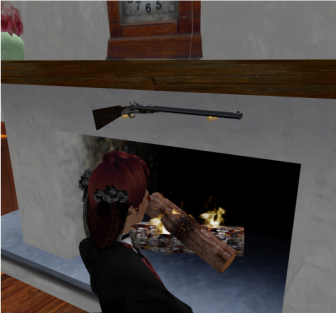
At the "Ft. Laramie" build for the vendor/orientation area of the redesigned Deadwood 1876 sim, Clay and September (and September's prim children, who I think should be named "Primmy" and "Lagston") meet Sergeant OHanlon. Yep. That will be my new new main avie after the restart.

So by now a lot of you have no doubt heard about the plans to take the time frame for the Deadwood sim back to the spring of 1876. At some point in March, we will have the big 1879 fire in the old build and it will be destroyed. After a very brief transition period we will be reopening with everything taken back to what it was like when Deadwood first started--a rough mining camp illegally sitting on what is supposed to be Indian land, and consisting mostly of tents and rough cabins. You can read about the decision on our forum, and also on Cici Levenque's blog Western Roles.

We're all pretty stoked about this. Deadwood was already unusual in terms of historical roleplay sims, in that time actually moved forward and the sim physically and socially evolved as that happened. It started over two years ago as a relatively primitive frontier town in mid-1876. Now it's a slightly more civilized place and the time frame has advanced to January 1879. Part of what made the environment unique was that it was always dynamic--things changed, people changed, the community changed. It wasn't one of those sims where stuff got built and the builder just walked away to go do something else. And now, we are taking the next step--we're going to trash it and start over.

Why? Well, partly it's because burning shit down or blowing it up is kinda fun. But it's also because a lot of us rather miss those rough and tumble days that the sim represented early on. And we learned a hell of a lot in the last two years--how to organize ourselves and our roleplay, how things should look, and how the people should look, how gold mining actually worked in the 1870s, and what kinds of new stories we could cooperatively develop and play out.

It's a pretty bold move on the part of both the owners and the residents but it will be an an exciting opportunity to put all that acquired knowledge to work, and to do something that to my knowledge, no one else has tried in SL yet. And it is going to be an opportunity to try to do things better, and in more authentic ways than they have been done so far.

One of these areas is the issue of recreating a 19th century military unit in SL. Generally speaking, the US army of the Victorian western frontier has not been represented terribly well on the grid as far as we have seen. Some groups have tried to do it right, but mostly it's been pretty iffy. I won't point to anything specific, because, hey, people do the best they can using the information they have. And mostly they're just trying to have fun. Well, we're going to try to take it to the next step and still have some fun--AND tie the military presence into the sim orientation and greeting process.

As with much of what we intend to do after the re-start, we have already started creating new avies, building new gear and clothing, and choosing what our roles will be and deciding what our new characters will be like. And as you can tell from the picture at the top of this post, sim co-owner and chief builder Caed Aldwych has already started working on the orientation area/Fort build. We want to have just about everything ready to go so that that the transition period will be as short as possible.

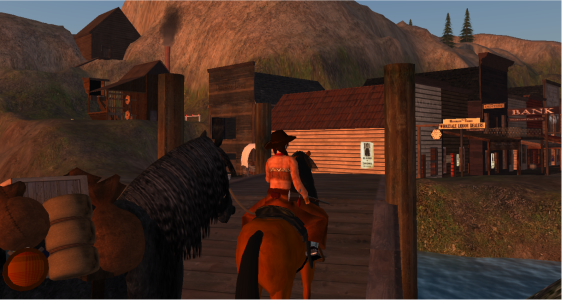
For example, I have already got my new avie ready, and Caed has finished a uniform and equipment set for our recreated unit. Like I said, we're trying to do this as well as we can, and the results--which my avatar is modeling in the screenshots with this post--are looking pretty good so far. You will note that Caed made an 1854 style cavalry shell jacket with the yellow trim removed (they were using up a lot of Civil War era surplus in the post war era, as well as forage cap, trousers, gauntlets and riding boots. He also made up an equipment belt with the M1872 belt and buckle, an M1874 cartridge box, and a holster for the SAA Colt pistol first issued in 1873. To go with all this, he also produced that pistol and a Springfield carbine. As I mentioned in another post, we are looking forward to additional M1872 and M1874 uniform elements from Astolat Dufaux, so we will be able to demonstrate the mix of clothing and accouterments that the plains cavalryman of the 1870s was wearing both in the field and on garrison duty.


Here's my new avie, Sergeant Major OHanlon, wearing uniform, cap, equipment and pistol all made by Caed Aldwych, and Ju Weissnicht's KBoots (since OHanlon is a senior NCO we wanted him to have something a little fancier than the issue boots that Caed has made to provide to the privates and junior NCOs). The skin and shape were made by DarkDharma Daguerre, and the hair is from Discord Design.


I don't know about you all, but I think he looks pretty good. Yeah there will always be things to quibble about--including the fact that yes, we know that our representation of Ft. Laramie is the earlier form of the fort, but Caed elected to do it in this configuration for logistical and stylistic reasons related to the orientation and vendor function of this part of the build. But, hey, I think it's still more authentic than other in-world western "fort' builds.

Now of course the appearance of an environment and the avatars in it is only one aspect of trying to do this right. There are also issues of information, and attitude. To this end, I would like to share with you the contents of the following two note cards that Sand Rau and I have been working on to help guide and inform the players who want to take part in this experiment:

Notecard One

Cavalry Units of the US Army on the Western Frontier
After the Civil War, the US army need to reestablish control in the western territories as well as occupy parts of the former Confederacy. Four additional cavalry regiments were added to the existing six. The 7th and 8th were white regiments. The 9th and 10th regiments consisted of black soldiers with white officers leading them. These regiments later achieved fame as the “Buffalo Soldiers,” a name given to them by the Indians.

After the Civil War, the Cavalry had a surplus of commissioned officers. Many had held high brevet (temporary) ranks during the late war. One such man was George Armstrong Custer, who had graduated from West Point in the class of 1861. At the end of the Civil War he held the brevet rank of Major General. These temporary promotions were rewards given for meritorious service. After the war he reverted to the permanent regular army rank of Captain. At a later date when he became second in command of the 7th Cavalry, he was appointed to the rank of Lieutenant Colonel. Hundreds of other officers were in similar positions. Ex-Colonels served as Captains, and Captains were served as Lieutenants. Though these men functioned at these lower ranks, they were entitled to be addressed according to the highest brevet rank they had held in the Civil War (hence Custer was addressed as "General").

Filling the enlisted ranks was another story. Most of the men who had served during the war were tired of fighting and returned to their families. Some experienced men who had served in the war did stay on--perhaps having gotten used to the life, or not having family to go back to. Among these were former confederate enlisted men--and even officers--who served as non-coms ( A number of years passed before ex-confederate officers were allowed to serve in the US army as commissioned officers).

Recruiting
It was extremely difficult to recruit men for this difficult, hazardous duty. For some men, the cavalry became a place to simply disappear. Most cavalry units operated outside the borders of the states and provided a new start in life with few questions asked. Early on, many of those enlisting in the cavalry had arrest warrants outstanding for them. Some joined the service as an alternative to serving jail time. Some judges believed that a hitch in the military would make a man out of the boy. In short, many of the enlisted men were criminals, adventurers and ex-confederate officers now serving as corporals and sergeants.

Immigrants, especially those from Ireland and German, also filled the ranks. Others came from England, France and Italy. John Martini for example was an Italian immigrant who became a bugler in the 7th Cavalry, survived the Little Bighorn battle, and had a long career in the cavalry.

One of the biggest challenges for these immigrants in the army was the language barrier. Organizational efficiency and communication was somewhat compromised by the fact that many of the American recruits did not read or write, and the situation was compounded by the reality that many of the foreign-born soldiers were trying to learn to speak english at the same time they were trying to learn the the ways of the army.

Pay
A trooper started off at the pay rate of $13 per month. By the time he finished his first hitch and re-enlisted this was raised to $15. At that point, he was commonly known as a “50 cent a day professional.”

Organization of the Cavalry
A regiment consisted of 12 companies, usually labeled from A to M. There was no J troop because in the handwriting of that era it was easy to confuse the letter I with the letter J.

In 1883, the term for a company was changed to "troop".

Four companies (or later, troops) comprised a squadron or battalion. A major commanded each squadron. The company itself was comprised of about 95 men,
broken down to the following ranks:

1 Captain
1 First Lieutenant
1 Second Lieutenant
1 First Sergeant
5 Line Sergeants
4 Corporals
2 Trumpeters
2 Farriers (horseshoers and
veterinarians)
78 Privates (approximate number)


Army Posts in the West
Various forts, both large and small, were established, mostly during the period from the 1850s to the 1870s, throughout the Dakota, Nebraska and Montana Territories on the northern plains, in the state of Texas, and in the New Mexico and Arizona territories of the southwest. As settlement, railroad construction, mining and agricultural interests spread in these areas, these posts were established to to provide bases for operations. A few had defensive elements such as stockades, blockhouses and/or earthworks. The majority, however, looked nothing like the stereotypical log fort shown in the movies--they were generally “open plan” posts, with no protective walls and consisting mostly of large barracks structures and other support buildings (stables, storage buildings, workshops, officers housing, etc.) arranged around a central parade ground. Attacks or raids by Native Americans on army posts was extremely rare. These posts might be garrisoned by either cavalry and infantry personnel, and sometimes were manned by a combination of the two. Garrison life in a fort was structured with most events of the day being announced with bugle calls. The day usually started at 5:30am with Reveille and ended at 10:00pm with the bugle sounding Taps. The working day usually ended at 5:15pm with Retreat, and this was followed up at 6:00pm with Supper Call.

A great deal of time in garrison was spent in drill (marksmanship training was limited due tothe army not wishing to spend a lot on ammo, but this changed after the Sioux war). A lot of time was also spent on grooming and caring for the cavalry horses--Stable Call was sounded twice a day.

Uniforms and Equipment
Uniforms and equipment right after the war was mostly left over gear from the Civil War. In the 1870s, new uniforms, weapons and equipment were gradually issued. On campaign the horse soldiers of the middle 1870s wore a gray pull-over 3-button shirt, the M1874 five-button fatigue blouse (a sack coat very much like the Civil War 4-button sack coat), a black slouch hat (usually with brass insignia on the front), sky blue trousers (with a branch of service colored stripe for officers and non-coms, and sometimes white canvas reinforcing on the seat and in-seams), and tall riding boots. Equipment included the 1874 McKeever cartridge box and the 1872 or 1874 saber belt with square US buckle, or the "prairie" belt with loops for ammo, the M1873 .45/55 single-shot Springfield carbine (firing a version of the .45/70 cartridge that had a lighter powder load to reduce recoil from the carbine), and the M1873 .45 SAA Colt revolver. The canteen, saddle bag and other gear were hung from the saddle. The M1860 light cavalry saber was issued to troops in this period, but usually was not carried in the field except by some officers.

Already working on backstory--note the service stripes on OHanlon's sleeve--they indicate 15 years in the service, including 5 years in the war.


Notecard Number 2

Background for the Recreated 2nd Cavalry Regiment at Ft. Laramie in the Deadwood Sim

Origins of Ft. Laramie as a trading fort

Fort Laramie was a significant 19th century trading post and
diplomatic site located in the area that becomes the Wyoming territory in 1868.

During the middle 19th century, it also was a primary stopping point on the Oregon Trail and the Mormon Trail and was, along with Bent's Fort on the Arkansas River, the most significant economic hub of commerce in the region. In the 1840s it was taken over by the United States Army to protect travelers on the Oregon, California and Mormon trails.

Ft. Laramie as military post

Fort Laramie, the military post, was founded in 1849 when the army purchased the old Fort John for $4000, and began to build a military outpost along the Oregon Trail.

For many years, the Plains Indians and the travelers along the Oregon Trail had coexisted peacefully. As the numbers of emigrants increased, however, tensions between the two cultures began to develop. To help insure the safety of the travelers, Congress approved the establishment of forts along the Oregon Trail and a special regiment of Mounted Riflemen to man them. Fort Laramie was the second of these forts to be established.

In the 1850s, one of the main functions of the troops stationed at the fort was patrolling and maintaining the security of a lengthy stretch of the Oregon Trail. This was a difficult task because of the small size of the garrison and the vast distances involved. In 1851, a treaty, the Treaty of 1851, was signed between the United States and the most important tribes of the Plains Indians. The peace that it inaugurated, however, lasted only three years. In 1854, an incident involving a passing wagon train precipitated the Grattan Fight in which an officer, an interpreter, and 29 soldiers from Fort Laramie were killed. This incident was one of several that ignited the flames of a conflict between the United States and the Plains Indians that would not be resolved for many years. A respite in the conflict came in 1868 when a peace treaty was signed at Ft. Laramie between the major northern plains tribes including certain bands of the Sioux and Cheyenne and the US government. Among other things, this treaty assured the Indians that they would retain title to the Black Hills, an area adjoining the Dakota Territory.

Fort Laramie in 1876

Unfortunately, the Treaty of 1868 did not end the conflict between the United States and the Indians of the northern plains. By the mid-1870's, major campaigns were being mounted against the plains tribes. The discovery of gold in the Black Hills in 1874, and the resultant rush to the gold fields had violated terms of the treaty and antagonized the Sioux who regarded the Hills as sacred ground. Under leaders such as Crazy Horse and Sitting Bull, they and their allies (primarily Cheyenne), chose to fight to keep their land. In campaigns in 1876-77, Fort Laramie served as a staging area for troops, a communications and logistical center, and a command and control point.

***********
Jobs and duties of the our recreated 2nd US Cavalry unit at Fort Laramie:

We are a group of Deadwood sim residents who will be forming a recreation of a company of horse soldiers from the 2nd US Cavalry, which served at the real Ft. Laramie in this era.

The U.S. Army on the frontier was there primarily for keeping the peace. But it also was sworn to faithfully execute the orders given to them by the legitimately elected government of the United States, and sometimes that meant carrying out policies that the soldiers did not make and may not have agreed with. However, like the members of the organization that we seek to emulate, we will do our best to follow our orders and carry out the assigned mission.

1. IC, our primary duty here is to maintain the peace between Indians and civilians. However, we may be called upon to expand that mission: in the early months of the gold rush, we will be the only official law in the area of the Black Hills. Remember, in 1876 this land is not yet officially part of the Dakota Territory. There is no local government or law except that which the miners organize themselves according to their usual customs and practices.

2. OOC we will also function as greeters and help new arrivals get started.

We will help any person who is new to DW sim, and provide them with any help they need (such as explanation of Rules and guidelines of the sim.) It is our duty to help anyone who asks or inquires of DW sim. So a good attitude, knowledge of how the sim works and its rules and guidelines, and good communication skills are a must.

3. We will function and behave in a way that honors and respects the memories and the heritage of the professional frontier soldiers who were given a difficult task and who, for the most part, sought to carry out those duties in a responsible and professional manner.

*************
Serving as a soldier in the DW sim:

Initially, 2nd US Cav will be the only official peacekeeping force in the DW sim, but we will not and cannot take a hand in dealing civilian situations until we are asked by a town or group of people for our assistance.

As a soldier you must be patient in acting on situations. For example, if you see bandits or hostiles attacking a civilian you never act alone, you come to the highest officer available and report the situation--the action to be taken from there will be determined by the chain of command.

This also applies for fights between civilians--HOWEVER, if any shooting or mischief takes place on the grounds of the fort, then and only then can a soldier can act on his own behalf. Likewise, in situations requiring self-defense or defense of a comrade, a soldier should act as his training and instinct directs him to. All incidents should then be reported to the chain of command.

Patrols

A major part of what the unit will do is of course to garrison the fort area. At other times, when we have enough personnel, we will make mounted "patrols," that may take us as far as Deadwood.

These patrols will be led by either the unit commander or a non-com.

**************

JOBS IN THE 2nd US CAVALRY AT FT. LARAMIE:

1. Officers and non-commissioned officers
a. Post commandant--Captain Sand Rau (note: Sand achieved the rank of Brevet Colonel in the Civil War, so although like most army officers he returned to his pre-war rank in the post war army--that of captain--he should still be addressed as "Colonel"
b. Regimental Sergeant Major/senior non-com (Dio alt, Sergeant OHanlon)
c. Sergeants (to appointed as needed)
d. Corporals (to be appointed as needed)

2. Medical personnel
a. Regimental surgeon
b. nurse(s)

3. Enlisted soldiers
a. privates assigned to fight as mounted troops
b. privates assigned to serve as gun crew for the mountain howitzers

4. Support personnel
a. cooks
b. ferrier
c. laundresses
d. sutler
e. post canteen bartender
f. quartermaster

5. Scouts and Interpreters
a. contract civilian scouts (white and African American)
b. US Army Indian Scouts (mostly Crow and Arikara warriors)
c. interpreters (can be white, Native American or African American)


***REMEMBER, ALL OF THE ABOVE DW RESIDENTS WILL ACT IN THEIR CHOSEN IC POSITION AND ALSO AS AN OOC GREETER***

The entry area to the DW sim and vendors will be in and around the fort (possibly including a "trading post" build). This is the only area that will be OOC and IC at the same time. 2nd Cav unit members and support personnel will be expected to be IC as much as they can when talking to or helping visitors to our sim. But when talking to or addressing an officer or other 2nd Cavalry member in open chat, you must be IC.

Since Fort Laramie will function as both an orientation and vendor area, 2nd US Cav members will meet all types of people. As time goes on, people will get to know you for who you are and we want their memory of you to be that you conducted yourself responsibly and honorably as a member of our unit and a representative of the DW community.

*****************

***Basic Unit Guidelines***

UNIFORMS: Unit members on garrison duty will only wear government issued blue uniforms (either the trimmed or untrimmed M1858 shell jacket and forage cap from older quartermaster stocks, or the M1874 sack coat and M1872 kepi--approved slouch hats may be worn in some circumstances on post). Garrison uniform will include sky-blue trousers with yellow stripe--white canvas trousers may be worn for fatigue duty such as stable call or KP. Accouterments will include the M1872 belt and McKeever cartridge box. All of these items will be provided to you though the unit once you are accepted as a member.

Campaign dress may include slouch hats (including approved civilian versions), the shell jacket or sack coat, buckskin jackets for officers, canvas trousers or trousers that have been reinforced with canvas, grey issue shirts, blue or grey civilian shirts, neckerchiefs, either standard equipment belt and cartridge box or the prairie style belts with ammo loops, and riding boots.

By the time winter comes an approved issue overcoat will be identified or developed.

SWORDS: An approved version of the M1860 light cavalry sabre will be worn for parade (but seldom on campaign). These will be provided by the unit once you are accepted as a cavalry member)

WEAPONS: for enlisted personnel--M1873 Springfield carbine and M1873 SAA colt pistol; officers, scouts and interpreters may provide themselves with other weapons that are historically appropriate for the period 1876. The government issue weapons will be provided by the unit.

HORSE: Enlisted combat personnel will use horses provided by a group horse rezzer with the army style saddle blanket. Officers and scouts may provide horses from other sources. Certain non-combatant personnel such as the sugeon, quartermaster or laundresses and cooks may utilize horse-drawn buggies or wagons of approved patterns (some wagons may be provided using group rezzers)

RANKS: Ranks will be assigned by Col. Sand Rau ((he wants you to know that promotions will be based on merit and attitude, and will not happen overnight...nor in a week, for that matter))

EVENTS: At any event hosted by either Fort Laramie or Deadwood ALL Cavalry unit members MUST wear full issue blue uniforms.

Military courtesy: Officers and non-coms will be addressed properly according to rank, and in garrison duty, will salute when appropriate (salute anim will be provided)

****************
A message from Col. Rau:

HOW I HOPE FOR US TO BE SEEN as members of the recreated 2nd US Cavalry: I want both our visitors and our residents to look upon us as those "Good ol boys of the cavalry" and/or "The nice helpful folks up at the fort." I want to have people respect our members and to feel safe with us. Having their respect is an honor, but remember that respect has to be earned by being honorable.

*******************************************************************

Ok so you're probably wondering why I went through putting all that information up here for you. Well, I was thinking that maybe some of you might look at that and say, Hey, I'd like to give that a try. But seriously, the main thing I wanted to emphasize there is that preparing for this big change isn't just about building stuff and picking out new skins. It's about sharing information, and ideas and expectations. A big part of the effort in getting ready involves learning.

Yes, we will still learn as we go, just like we did with Deadwood during the previous couple of years. Yeah, it's also hopefully gonna be fun, and we'll get to whomp up some kick-ass storylines and have some action, suspense, drama, and the occasional comic moment.

But we're gonna have history too.

So like I say, we are real excited about this. I will keep you updated, and we will also probably talk at some point soon about some other areas of concern--not the least of which is how Native Americans will be represented in this experiment. There are some real complex and emotionally charged issues to deal with here. You know, it's most likely not going to turn out how we expect or hope (remember nothing does in SL). But it should be interesting.

~~~

Thursday, August 20, 2009

A Deadwood story -- the dangers of cards

~~~
This is a new story, that hopefully will serve as an instructive lesson on why playing cards will lead you astray and get you into situations you didn't expect...


So ye say yer wonderin’ about how I became the proprietor o’ the famous Saloon Number 10 in Deadwood City, the place made notorious by the cowardly assassination of Mr. Hickok.

Well it was like this...

I was doin’ all right with the laundry. Actually more than allright. There are those who say that in a mining boom, the majority of the gold is found “from the grass roots up.” It ain’t far from the truth: actually diggin’ the yellow metal is hard, unpleasant and uncertain work. But providin' services 'n food, an' entertainment to them who are doin the diggin’ is a pretty sure bet. Yeah, it’s still had work, but ye stand a better chance o’ findin’ yer fortune.

So with what was comin’ in, I’d paid m’ debts an had enough resources to take on a couple helpers, a Celestial and a Irish gal, and then together we could do even more baskets o' soiled shirts an' whorehouse linens in the course of a day, an' that made us even more money.

So I had me a little bit extra to spend on a luxury or two. I got a wash stand fer m’ lil’ room in the back o’ the laundry: a real nice cabinet o’ light-colored wood, with a bar on which to hang my towel an’ face cloth, an’ a basin ‘n pitcher fer t’ carry out m’ mornin’ ablutions. Well sir, even after that, I still had some extra coin burnin’ a hole in m’ pocket, so I went to see m’ pard, Ron the gunsmith.

I mean, hell’s britches, a gal needs to spend a little bit on herself now an agin, right?

Git herself somethin’ pretty?

You bet.

Well, Ron had in his display case this damn fine lookin’ Griswold--a rebel-made copy of a Colt Navy. This one not only had the brass frame, which Ron had polished up real nice, it had bone grips, an' there was this fancy silver-washed engravin’ o’ lil’ flourishes 'n curly-cues on the metal. Twas obvious this had been an officer’s side-arm and somethin’ that had been greatly treasured by someone.

I jus’ HAD to have the piece.

Almost directly after I had made the deal and was standin’ there admiring that iron with Ron, along comes Carl, the remainin’ owner o the Saloon Number 10. I say “remainin” as his other partner had done took off an’ left him with the saloon, which was not doin’ well in the months after Mr. Hickok’s killin’. Folks would come in to look at the table where Bill was slain, but they warn’t inclined to pass an idle hour in the place. Bad feelin’s I reckon.

Anyhow, Carl from the 10 sees me cuddlin’ the Griswold, an he starts waxinelequent on what a fine piece it is, an’ inquires if he might buy it. Ron o’ course says no sir, it’s already been sold to this here lady, an’ Carl gets adamant with me that I should sell it to him. I get equally adamant that I shall not part with it fer any price, and one thing leads to another an’ Carl--who may have already been test samplin’ his wares that mornin’--says he would like t’ challenge me at cards fer the pistol. An’ I ask what will he put up against the firearm fer me to take should I win, an’ he thinks a moment...an' he up an decalres he will put his saloon up against it.

I look at Ron an' Ron looks at me. An’ I nods an’ says ok. Carl then says, allright missy, be at my saloon in half an hour, an’ then we shake hands an' he stumbles out.

So I turn to Ron an’ say, “Pard, would ye mind accompanyin’ me on this? I got a feelin’ this could turn out more ugly than I care to deal with on m’ own. An' Ron replies, “I would be glad to, Miz Dio, bein as ol’ Carl there, he is known to be an occasional cheat at cards...I was figgerin' I should observe 'n make sure he plays honest.”

At the appointed time we head on down to the Number 10, an' I tell ye what, the place was even more of a shithole than I had recalled. Dirty, grim, an’ cheerless. Carl had boarded up the back door that the assassin had used to sneak up on Wild Bill, an it was quite dark inside. The bar had no rail, the glasses 'n mugs was chipped an’ fly-specked, an’ the whole place smelt o’ blood, piss, puke, an’ stale tobacca smoke.

Carl, he steps up an' greets us most cordial-like, smiling at me though a set o’ irregular brown teeth. I return his salutation an’ I says, “what’s the game?” He says, “what do ye wish?” An’ I replies, "oh hell, Carl, I got things to do, let’s just cut fer it."

He shrugs an' says ok, an' then he hands the deck to Ron to shuffle it. Ron shuffles an’ slaps it on the center o’ the very table where Bill Hickok's brains 'n blood darkened the wood. Then Ron steps back to a advantageous position where he can observe the process, casual-like, but with good effect.

Carl nods an’ says, “After you Ma’am.” So I pull off a part o' the stack and show the bottom one, which proves to be a Jack o’ Hearts. Carl nods and pulls his part o’ the stack...

...an’ he shows a deuce o’ clubs.

He looks at me an says, “Oh well, I woulda liked to own that iron. Tis’ a truly nice piece.” He tosses me the key to the front door an’ grins a bit. “The landlord likes the rent by the first o’ the month. He ain’t azactly overflowin’ with the milk o' Christian generosity, so if’n yer a gonna be late with it, I suggest ya hide well, an’ then claim later on ya was kidnapped or carried off by injuns or somethin.”

An’ he walks out the door, justa-whistlin’ like a man who ain't got a single goddam care in the world.

So I’m lookin around at this depressinlilshithole of a booze parlor, startin’ already to be thinkin’ on how I kin clean it up an’ make it look nicer with some more coal oil lamps an' some chromolithographs on the walls, an a decent foot-rail...an’ I was already formulatin’ a plan to make it jus’ a lager beer saloon like I seen in Cincinnati in the German district, so respectable wimmen 'n young’uns could come in t' enjoy the place without fear o’ bein’ given offense by some whisky-soaked drunken idjit...

An’ I turn to Ron an’ say, “Pard, I am greatly obligated to ye fer bein’ here to ensure that he din’t cheat with the cards there...

Ron smiles a funny lil’ smile, looks around that wretched rat hole of a saloon, an' says to me, “Well Miz Dio, fact is, he did cheat...I saw him plain as day: he had that deuce ready in his palm an’ slipped it on the bottom of his stack when he cut.

I laughed, “You mean that wily ol’ cockchafer done cheated me into takin’ this piss-pot waterin’ hole off’n his hands?”

Ron jus’ grins an' says, “I shall ask Mr. Bu to send o’er some o’ his ‘nephews’ with buckets an’ scrub brushes, and I’ll fetch m’ carpentry tools. We may as well git started. Ya need to be bringin’ in some money right quick, if yer gonna be ready to pay that rent on the first o’ the month.”
~~~

Wednesday, July 29, 2009

A Deadwood story -- yeah, I shot the sheriff, part one

~~~
This is a story based on an rp scenario that just happened -- nothing planned, but it all worked out remarkably well. It was a complete hoot to be a part of. The original transcript that it was developed from is posted on the The Road to Deadwood forum.


The side by side, break-action double gun that features prominently in this story...still well loved today even if sort of retired...


Dio had just acquired a new toy: a lovely Belgian-made break-action, breech-loading, double-barreled 10-bore shotgun, with a 3-and-a-half-inch chamber and 32-inch damascus barrels. It was big, the barrels had a gorgeous browned finish, and Dio had it loaded up with double-aught buckshot--18 big pellets to each round. It was, quite simply, a monster...and Dio was in love with it. As she was heading up Main street towards the hills to try it out, she was suddenly distracted by as series of noises -- shots, and then shouting -- from the direction of the Bella Union. Dio instantly rushed over to find a small crowd gathering outside: Sal, the Bella’s manager, a cluster of her working girls, and Federal Deputy Marshal Sand Rau.

“What happened Sal?” asked Dio.

Jesse, one of the Bella girls replied, pointing up the street at a large figure that was disappearing towards the creek, “That man there! The one walkin' down the street...he shot Pel!!”

Sal interjected in an air of disgust, tinged with anger, “That Mr. Hawk shot Pel, my new bartender, when he asked him to pay for his cigars...”

Jesse went on somewhat frantically, “He's walkin' down toward the river...past doc's office!...He jes’ up and shot 'im! Fer no reason ‘cept a seegar!!!”

Dio peered up the street at the man, who even at this distance she could tell was unusually tall and solidly built. She turned to Marshal Rau and said calmly, “Go git ‘im Sand, I'll look after the feller what got shot.”

As the lawman took off loping up Lee Street, and the other girls tried to get Jesse settled down, Dio accompanied Sal into the Bella. There, leaning against the bar was a thin, strikingly handsome man. This apparently was Pel, the new bartender. Old Bill Deerhunter was pressing a bloody bar rag against the man’s leg trying to staunch the flow of blood.

“Let’s get him settin’ down, so Miss Dio can look after him,” said Sal in a calm and determined voice. Dio carefully set her new shotgun behind the bar, while Old Bill and Sal assisted the injured man in hobbling over to the sofa.

“How bad ye hit, pard?” Dio asked, as the others helped Pel to ease painfully down on to the poor sofa, the upholstery of which already had more than the usual number of stains from various body fluids that had leaked out of Sal’s customers and employees over the last few months.

Pel, grunted and lifted up the bloody cloth. “I believe it is nothing more than a wound through the flesh...I don’t think the bone was hit, but it does seem to be bleeding rather freely...”

Dio was about to say something about how she “had seen worse,” when suddenly, Marshal Rau dashed in.

“Hey who was it or who am I lookin’ for?"

Old Bill looked exasperated. “Twas that blasted Hawk again!”

Sal looked even more irritated. “DAMMIT SAND...MR. HAWK!”

“The big man, with a big beard!” added Jesse.

Old Bill chimed in again, “His name is Hawk and he just went down the street!”

Marshal Rau still looked a bit perplexed.

“Yes,” said Sal...he’s a large bearded man....a bit ripe, you can’t miss him.”

Old Bill nodded. “Ugly too. Ugly and MEAN.”

The light of comprehension seemed to be dawning in Sand’s eyes. “Which way?” he asked.

Miss Zoe came in at that moment. “Hawk? He was just walking down the road right behind me!”

Jesse had an expression of extreme frustration. “Like I said before, past the doc's office!”

“OK!” said Sand and he rushed out again. Old Bill looked at the people in the room and shrugged. He then followed the Marshal.

Jesse watched them go and sighed. “Nobody ever hears me,” she commented plaintively.

Meanwhile, Dio was concentrating on Pel’s wound. She unsheathed her skinning knife and cut away the blood-soaked cloth of his trouser leg. The bullet seemed to have passed through Pel’s upper leg, going at an angle from the front to the side. Dio noted that the entry wound seemed fairly tidy, but the exit point was a bit more ragged and appeared to be the source of most of the bleeding.

Sal came over to watch. “Can you fix him up Dio?”

Without looking up from her work, Dio replied matter-of-factly, “Reckon so, Hon...say, Sal, could you start boilin’ some water, heatin’ up a poker in the stove, and git me some clean cloths?”

“All right.” Sal nodded and set her girls to the requested tasks.

“Oh, and I'll need some whiskey, too,” Dio added.

“So will I,” said Pel.

Sal smiled at him. "Well I know Miss Dio wants the whiskey to clean the wound...I assume you want some of that whiskey to take the edge off?"

Pel tried to force a smile. “Ladies, I trust you won’t think any the less of me that I could use a drink right now.”

“Of course not,” Sal said gently, as she handed Pel a glass of rye, and then passed a full bottle of the cheap stuff to Dio.

“Thanks, Hon,” Dio nodded as she took the bottle of raw whiskey and began cleaning the area around the wound. While mopping up the oozing blood with a towel, she peered at the various holes in Pel’s leg. She took some large tweezers from her hunting bag and carefully pulled some bits of cloth out of the entry hole in the man’s limb.

Pel made a hissing noise and his eyes watered slightly.

Dio grinned at him in spite of herself. “Oh, by the way, Pel, did I mention that most o’ this was gonna really hurt?” She began cleaning out the wound with the whiskey, pouring it liberally over the injury. “Matter o’ fact I guess I shoulda let ye know it was gonna hurt jus' like the Divil himself was pissin’ brimstone into that hole there.”

Pel was a greenhorn, and something of a dude at that. Educated, well spoken, a lawyer back east. All in all, Dio was pretty favorably impressed with how he was handling this ordeal so far. But he needed to be prepared for what was coming.

“Pel, I am gonna fix yer bleedin’ by puttin’ on a hot poker to sear it closed. If’n ye thought the cleanin' part hurt, this is gonna be like a visit from the grandmother o’ that pain...Sal, I’d be obliged if’n ye’d give him some more whiskey.”

Sal came back over and handed Pel a bottle. Without a word, the man began draining its contents. Sal looked at Dio and asked, “Ready for the cauterizing and then bandaging?”

Dio nodded. “Ready, Hon.”

Sal turned to Jess and instructed her to fetch bandages and the poker from the stove. The girl brought over the clean cloths and the poker, which was now glowing a dull cherry red at the tip. She looked at the wound and winced.

Dio carefully took the poker and noting Pel’s blissfully vacant expression she went ahead and pressed it to the source of the bleeding in the exit wound. Pel’s eyes went wide for a moment and then he made a curious gurgling noise through his gritted teeth. Otherwise he was remarkably quiet.

The room filled with the pungent fragrance of burning flesh and blood. Dio handed the smoking poker to Sal who set it into the coal scuttle by the stove.

"Done with it?” Sal asked.

“Yep.” answered Dio. “I think we’re good.“

To her surprise, Dio looked up to find that Pel was watching her intently, his face streaming with rivulets of sweat.

Dio smiled at him. “Yer gonna be fine I think...we din't havta cut out the pistol ball or nothin’....looks to be you took it clean through the fleshy bit o’ thigh here.”

Pel grunted, “Did it have to be the painful fleshy bit?”

Dio shrugged as she bandaged the wound. "Well shit pard, better than hittin’ a bone or big blood vessel or some such...Jess, Hon would you bring me that pot o’ water what’s a bilin’?”

Jess wrapped a cloth around the handle and brought it over. Dio dipped the last clean towel in the hot water and began washing off the blood that had run down Pel’s leg. Then she began washing the clotted gore from her own hands.

At that moment Sheriff Daz Perun entered the Bella. “Good lord! What the hell is goin’ on here?!”

As Sal was explaining the situation to Daz, Old Bill came in, his eyes flashing with disgust and anger. “Lost his blasted trail down around the chinaman’s place...Sand is still lookin’ for him, though...”

Just then, Mahaila Bertrand entered the Bella and dryly observed, “Well if Sand is still looking for the man, he’s just going to have to go in a big circle.”

Everyone in the Bella bar room went silent and as one, looked at Mahaila with a mixture of curiosity and befuddlement.

Mah looked back and continued, “Sand’s looking for Hawk, right? Big, crazy bearded man, right? Well he’s right outside -- across the street by the Gem.”

to be continued
~~~

Monday, July 6, 2009

Dio's Story, part seven -- the search in the hills


reposted and edited from the The Road to Deadwood Forum
:

She knew it was going to be hard finding Sepp and his detail up in the hills. She just hadn't realized how hard.

"Shit," she thought at one point, "these boys are pretty goddam good."

She had figured that Sepp would use every trick he knew to stay hidden from both the miners and wandering groups of hostiles or bandits. And by God, he didn't disappoint her.

Sepp had been trained by the same old rangers and hunters who had taught Dio how to not make obvious trails; to move noiselessly; to leave no evidence of having passed by or where you were going. When she talked to the men in the gold camps, asking if they had seen any bluecoats, they could only tell her vague stories about grim and silent riders who seemed to move like ghosts, suddenly swooping out of the dusk to grab a suspected deserter for a "little chat," or pouncing without warning on small groups of road agents or horse theives.

The only signs she could find were the occasional blurred and masked set of tracks, more often than not suddenly vanishing into a creek bed or over a rock face. And every now and then, Dio came across some freshly mounded dirt, marked with a bit of board or a slab of bark stripped from a nearby tree, and bearing grease pencil inscriptions such as "unknown hostiles," or "deserter," or "unknown bandit, executed 1876."

Dio would spend several days or a week at time, trying to pick up Sepp's trail. When she ran out of supplies, or the signs were cold or nonexistent, she returned to Deadwood, making a brief visit to rest her horse, pick up fresh ammunition and food, and maybe even do a few loads of washing in order to raise some needed funds. But within a day or two, she would be heading back into the hills to continue the search.

Even as she tried to follow Sepp's detachment, she knew she had to be as careful and cautious as they were. One time, Dio thought she had found their trail. She had come across the tracks of a small group of shod horses, hidden as much as possible, deliberately obliterated or made misleading by means such as backtracking in streams--all the tricks that someone like Sepp would be using. But when the freshness of the tracks told her she had caught up with the group she was following and that they were probably just over the next hill, she didn't simply go riding over the ridge like some feckless greenhorn. Instead, experience and instinct told her to tie her horse some distance away, and silently belly crawl up the slope to take a look first. There, she saw not a squad of army scouts and troopers, but a little band of Cheyenne warriors, resting a small herd of horses they obviously had stolen from some white settlers or miners--hence the tracks of shod horses, rather than shoeless Indian ponies. As quietly as possible she backed down the hill on her stomach, made a dash for "rented hoss" as she called her mount, and got the hell away from there as quickly as she could.

Meanwhile Sepp also made some stops in town--but always by himself, never bringing in his detachment. This was partly to keep them from falling prey to the trouble that lay waiting for tired, thirsty, recreation-starved soldiers in a place like Deadwood, but also to conceal how small his detail actually was. During the course of one of these stops in town to pick up supplies, he learned the truth--that Dio was alive, that she was in this town--this miserable little boomtown--and that she was out in the hills looking for him. On discovering this, he left a note with an elderly Chinese gentleman who lived next door to Dio's laundry, telling her to stay put, that he would come find her, that going out into the hills on her own was too dangerous.

And it certainly was dangerous.

Inevitably, Dio let her guard down for just a moment while taking a rest and was surprised by a miner who thought he could have his way with her. As he worked on undoing his trousers, he never saw the sudden flash of the boot knife that caught him in the throat. With a second and third quick slash, Dio cut his jugular vein and then sat panting, as she watched him bleed out. Seeing the man die before her eyes, Dio 's rage grew--every flint-hearted banker, drunken bastard, lecherous swine and greedy prick she had ever known in her jumbled life became personified in this gasping, wreck of a human, staring at her with terror and pain in his eyes. That look of terror grew as she told him what she was about to do.

When he finally expired, she grimly stood up and began taking everything he had...horse, gun, gear, clothing, and finally, the kind of mementos she had learned to take from a fallen enemy when she rode with Sepp's Apache and Tonkawa rangers.

The next day, when a party of prospectors stumbled upon the naked, scalped, and emasculated body of a white man whose throat had been cut, they assumed it was evidence of yet another attack by hostile Indians. When they noted that his chest had been opened and some major organs removed--and apparently left out to feed the wolves and coyotes--they were convinced that here was a clear message from the Sioux, telling interlopers such as themselves to leave the Black Hills or suffer the consequences. A couple of them did actually decide to give up and return to Iowa that night.

Even as the frightened fortune hunters were packing their gear to head back east, a small figure in buckskins and a battered, broad-brimmed hat slowly rode into Deadwood, leading an extra horse and cradling a new carbine. The old slouch hat was curiously decorated with a few wild daisies stuck in the band. Her saddle had even more curious decorations--a scalp and what appeared to be a severed set of male genitalia.

Deadwood was not a place for those who were faint of heart or weak of stomach. Dio was neither. And she had no intention of going anywhere else.
~~~

Sunday, July 5, 2009

A modest real life adventure -- prospecting on the American River

~~~
I had a little adventure on Friday that I wanted to share with y'all (but I had other things that had to come first, so I'm doin' it now). It was one of those "Kon-Tiki" experiences that give you some small insights into people's lives in the past: my friend Aldo and his father-in-law Gregg invited me along on a gold prospecting trip to the North Fork of the American River, a little ways to the east of Sacramento, California.

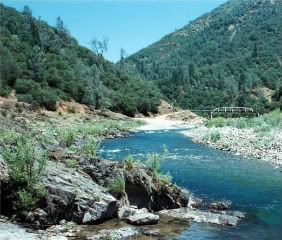
When they asked, of course I said "Hell yeah," and laced on my old Corcoran boots and met up with them for about an hour drive, the last portion of which went down a winding dirt and gravel road that was scraped into a pretty steep hillside. This triumph of engineering led down to the Ponderosa Way bridge (see picture, above), where we disgorged from the jeep with gear that included shovels, five gallon buckets, a small pick with a scoop blade, a sifting box, a little portable sluice box, a gold pan, and some other miscellaneous accessories of low-tech mining. We climbed over a low barrier and went down to river bed. The water was fairly low and moving kind of fast. The exposed part of the river bed was a field of loose, rounded river rocks (some qualifying as boulders), sand and gravel. We then hiked a ways over the rocks, heading downstream from the bridge until Gregg saw some likely looking spots among the boulders and gravel of the bar.

We spent a good part of the day digging up gravel and sand, sifting it into the buckets and then putting the resulting material one handful at a time into the sluice box (which was set into the flowing stream so water was running through it). The water washed away the lighter sand and gravel, leaving the heavier bits (including hopefully, some gold) against its "riffles" (small ridges). Finally, when it looked like the crap was mostly gone, we took the remnants and did the panning thing, swirling it around in the pan and washing away more of the light material.

It was a wonderful, wonderful place: absolutely beautiful. The river water was clear and cool and the rocks, though a pain in the ass to hike over, were fascinating. Gregg pointed out various piles of rocks here and there which he identified as "tailings" from earlier mining operations, perhaps going back as far as the 1850s.

In the course of the day, the three of us actually found two minuscule flaky little pieces of gold, which Gregg carefully retrieved from the pan with a little suction gizmo and put into a jar.

I can't tell you what those little reddish yellow flakes might be worth, but I can tell you that finding them taught me a couple of things, things that I think have a significance for those of us who are trying to create stories about life in a 19th century gold mining community.

First and foremost, placer mining for gold in the old, hands-on way that guys did it in the 19th century is goddam hard work.

You are mostly bent over or squatting. You are pulling up big rocks and tossing them out of the way so you can get at the finer material -- the sand and fine gravel -- that lies underneath and around the bigger stones. Much of the time, you are scooping up this stuff with your bare hands to put in the buckets, because the shovels, and even the little scoop/pick tool, are too unwieldy to get the sand and gravel out of the crevasses. And Christ it sorta made your brain hurt -- Aldo and I spent a lot of time squinting at the sand and gravel as we washed it through the sluice and then swirled it in the pan, concentrating so terribly hard, like badly-trained mentalists trying to bend a spoon with brain waves. We were both scared shitless that we would accidentally wash away something that was of some value.

But Gregg was a lot more blase' about it all. He's been doing this stuff for years and he says it just gets to be second nature. And he was really, really nice to not give me a ration of shit about my spectacularly inept efforts to swirl the sand and gravel and water in the pan in the proper way. I could just imagine the grief that oldtimers probably would have shoveled on to some poor, feckless, dewy-eyed greenhorn who was trying to get the hang of it for the first time.

So we were doing this for only one day, and it was kinda rough on the knees (though we wore knee pads) and on the back and on the fingers. And I'll admit all three of us are older and more sedentary than your average historical 49er. But goddam, it gave me a whole new level of respect for those guys. Especially the ones who got to California by taking a fucking hike across several thousand miles of prairies, mountains and deserts to get there.

The experience also made me ponder some things. One thing I noticed was that here we were in this astonishingly beautiful place, and before long, you stopped seeing it. Your eyes were focused down: among the rocks, in the sluice box, in the pan. Were the argonauts of the past blinded to nature's wonders in the same way?

And I wondered if the guys in the 19th century talked at all while digging, running a sluice and panning. I know we didn't have much to say, other than things related to the work itself:

"How about this spot?"

"Hand me that bucket."

"Is this anything?"

"Watch your fingers there..."

I could also understand how if you did this for weeks, or months, or even years, it probably aged you prematurely. And I could see how other ways of making your living -- blacksmithing, bartending, gambling, robbing stagecoaches, stealing chickens, or farming -- must have become very, very attractive sooner or later. Especially in the valleys of California, where it never snowed, the land was fertile, and all kinds of stuff would grow, did the lure of the yellow metal ever completely fade, or did it hold you in its grip forever?
~~~

Friday, June 26, 2009

Dio's backstory, part three -- after the War, a wanderer


reposted from The Road to Deadwood Forum


Unaware that Sepp had survived the war and had come looking for her, Dio began months of wandering from place to place, looking for a situation in which she could start her life again. All she managed to do however, was to fritter away most of her small cash reserve on alcohol.

In Missouri, she encountered one of her former ranch hands, a skilled and honest cowboy named Adar Merlin. He agreed to help her look for Jack's grave near Vicksburg, and they spent months trying to locate his final resting place. Dio remembered very little about the trip, as she was drinking even more heavily at the time. Adar claimed they never found the grave, but when asked, he would always refuse to provide any details about what had transpired.

Adar subsequently found Dio a position as cook at a ranch where he was working in Kansas, but her alcoholism eventually led to her being dismissed. After parting ways with Adar, she managed to start making some steady money working with a aging buffalo hunter who was too ill to hunt as successfully as he once had. Dio did most of the shooting, while the man handled the sale of the tongues and hides. Being in the wilds, away from people and sources of whiskey, helped Dio dry out a good bit. Several years passed, and when the old hunter finally "succumbed to his afflictions," Dio had managed to save enough of a nest egg to move to the Arizona territory and make a down payment on some land with the intention of taking up ranching again.

Meanwhile, Sepp had made a deal in which he was cleared of the murder charges in Texas and joined the United States Army as an enlisted man. He continued to seek information about Dio's whereabouts, but kept running into dead ends. Within the inner pocket of his jacket, he carried a locket with Dio's picture--a memento that Jack had carried with him until his death in the war, and which Sepp had reclaimed from his best friend's mangled remains.

By the time he was serving in the U.S. cavalry, he had convinced himself that Dio needed to know how much Jack had loved her, and he became quietly obsessed with finding her someday. Being in the army, however--one of the conditions for having the murder charges dismissed--made spending much time tracking her down somewhat problematic.

Out in Arizona, Dio did her best to make the new ranch a success. However, she lacked the capital to do so and within a few years she started to drink again. One day, in a seedy booze parlor in a grim little mining town, she got into a conversation with a Navajo medicine man who went by the unlikely name of Clyde. Dio enjoyed talking with the wise old fellow and listened with interest as he spoke of his people's belief in the need for balance in all things. They met and talked a number of times, and Clyde--never judgmental, always soft-spoken--asked her questions that made her think very, very hard. In their final conversation, Dio said that she wanted to give up drinking: that she knew her life was unbalanced. She knew she had a serious problem with alcohol, and she wanted--no, she needed his advice and guidance. Clyde listened, smiled, and before he walked out of that saloon, he poured her a shot of whiskey and told her that she "would do what she had to do."

Dio looked at the glass of golden liquor for what seemed an eternity. She picked up the glass and looked harder.

Then she poured the whiskey into a nearby spittoon.

After gently setting the glass on the bar she strolled out into the blinding, dust-flecked sunlight of an Arizona afternoon.

She would never have another drink as long as she lived.

hey, boys and girls, don't forget to check in for the final episode!
~~~

Dio's backstory, part two -- a west texas ranch wife


reposted from the Road to Deadwood Forum


Though Texas, both as a Republic and after gaining statehood, allowed slavery, Dio and Jack never held any enslaved people. However, on one occasion, Jack won a card game in San Antonio and to his surprise found that the pot included the papers of an older enslaved man named John Husar. Jack often commented that it proved to be the most expensive card game he ever won, as he promptly manumitted the man, and then he and Dio spent considerable time and money locating as many of John's family as they could and purchasing their freedom. A number of them, including John and his grandson settled near Jack and Dio's ranch.

Sepp, meanwhile, grew bored with ranching, and joined the Texas Rangers. He eventually wound up organizing and leading a mixed company of Rangers, made up mostly of Lipan Apaches and Tonkawas (traditional enemies of the Comanche), Tejanos, and a few radical German immigrants who had migrated to Texas after the revolutions of 1848. When Dio and Jack were having serious arguments, she would occasionally go riding off on patrols with Sepp's company of Rangers. It was during these excursions that she acquired the bad habit of taking a scalp--or other souvenirs--every now and then from a fallen enemy.

When the war came, Jack decided that he wanted to volunteer to fight for the Confederacy. Sepp at first wanted nothing to do with it, having a deep seated hatred for the wealthy elite slave-holding planters and ranchers that were at the pinnacle of southern society, but out of his friendship for Jack he decided to go with him and try to keep him from getting killed. One of Sepp's uncle in East Texas was helping to form the 3rd Texas Cavalry, so the two went and volunteered for that unit. As Sepp was educated and an experienced leader, he was elected to be an officer, eventually becoming a Captain. Jack served as his First Sergeant.

Sepp and Jack were in a number of close scrapes, but always made it through all right until May of 1863, when Jack was killed by Union artillery fire near Vicksburg. Sepp was wounded by the same shell. He lost an eye, and being in hospital when Vicksburg surrendered in July, he spent the rest of the war in northern prison camps: principally Camp Douglas in Chicago and Rock Island. During the course of the war, Dio had received exactly 5 letters from her husband, who--being illiterate--had dictated them to Sepp. No word from either of them came after mid-1863.

In the meantime, the State of Texas had pulled its ranger units away from the frontier in order to use them in the war effort against the North. The Comanches took advantage of this, pushing the line of settlements back almost 100 miles in some places, except in the area around Dio's ranch. Sepp's Tejano, Apache and Tonkawa rangers had all chosen to leave the Texan service and settled in that vicinity with their families. Their presence made it a relatively safe place, though to support and feed all these people, Dio had heavily mortgaged the ranch. When Jack didn't come back--and she was no longer able to keep up the payments, the bank began foreclosure proceedings. In June 1865, a few of Jack's comrades arrived at the ranch to tell her what happened to her husband. They presented her with a battered blood-stained gray cap and she knew for sure he would not return. Dio began drinking heavily, and was unable to stop the foreclosure and auction of the ranch. She said goodbye to the people who had settled around her home and disappeared.

On the day of the sheriff's auction Sepp arrived, only to find Dio gone, and his old rangers and friends dispersed. Only a couple of the Tonkawas and John Husar's grandson still remained. He saw Jack's cap still lying on the kitchen table and took it with him. On the way out, he learned that the ranch had been purchased by a wealthy landowner who had managed to avoid serving in the war.

Two weeks later, four men--two Indians, an ex-Confederate officer, and a young Black man--were on the run for having killed a county sheriff, a bank owner and a well-to-do land speculator. But that's another story.... you probably want to know what happened to Dio.
~~~

Thursday, June 25, 2009

Well, we might as well get this started...


a word from Dio's typist...


I guess I am on my way to being less of a cyber-luddite after all. I actually put my real self on Facebook recently (and no I ain't about to direct you to that, just because I'm trying to maintain some separation between the different worlds that Dio and "her typist" inhabit). And yes, I have signed up for that Twitter idiocy, though I haven't brought myself to actually use it yet. And hell, I have been wandering around in Second Life for over four years now.

And by the way, I just got Dio a new skin that looks a little less pale--it was probably originally made for goth-type purposes. Anyhow, I finally broke down and got her a more detailed skin, with a healthy outdoorsy glow, which seemed appropriate for a character whose backstory and present in-world lifestyle involves a good deal of outdoors activity.

Actually, I was always kind of afraid to change how she looked. She had that same skin since 2006 or so, and, well, shit, I suppose I was worried that altering her look might somehow change the persona. But being as Dio has taken on such a life of her own, I don't think anything I might do is going to make much difference in how she acts, talks, or what she might do to offend "civilized folks."

So anyway, yeah, another big step..starting a blog for Dio.

One of the reasons I'm doing this is because she has been character in a number of really good stories and rp sessions--mostly in the sim known as Deadwood 1876--and I am going to re-post some of those pieces here, over time. The Deadwood community forum is a great place, and I love posting there, but those old stories have kind of gotten buried. I just want to give them a little fresh air, let them run around in the sunshine for a few minutes, and see if anyone else might enjoy reading them. Not that I actually expect anyone to read this turkey, but hey...you never know.

I hope to hear from some of you who share my interest in the possibilities that Second Life offers for historical recreation...for having fun learning, exploring, and playing with stories from our collective past. Second Life is many things--and yes, for so many folks it is a festival of virtual consumption and unbridled lust--a pixelated vale of tears with drama queens, attention whores, self indulgent narcissists, cyber pin-heads (literally and figuratively), and some really, really creepy motherfuckers. And that's fine (other than the creepy bits). There is a place in our lives for recreational drama and everyone needs to get attention some time.

But there is also so much potential to really experiment and play with the realities we choose to inhabit....to engage one another, to connect, to learn and share and create. For those of us who love history and who have found this to be a way to tell stories--to be a part of storytelling in a very direct, improv theater sort of way...it's so much more than sex and shopping. Though yes, some of us find those elements of it worming their happily wicked way into the mix no matter what..but then we're just human after all.

So if you happen to pick up this bottle floating in the cascade of ideas and information and lies and wishful thinking that pours into your lap from your computer screen, I hope you enjoy reading the note inside.
~~~