Showing posts with label fun with history. Show all posts

Sunday, September 12, 2010

Looking for signs of ancient life in SL, part II

~~~
In my first house in Alsium.
~~~
I've been putting this one off for a while, for no discernible reason other than laziness and a temporary preoccupation with so-called real life. But I guess it's time.

I had promised that I would follow up with you all both on the subject of "looking for signs of ancient life" in SL, as well as providing a bit more detail about what I've been doing with myself during the last three months or so. Not that it really matters what I've been up to, but perhaps talking about my ongoing journey can shine a bit of light on some interesting aspects of what is taking place in certain corners of the historically-themed sims in-world.

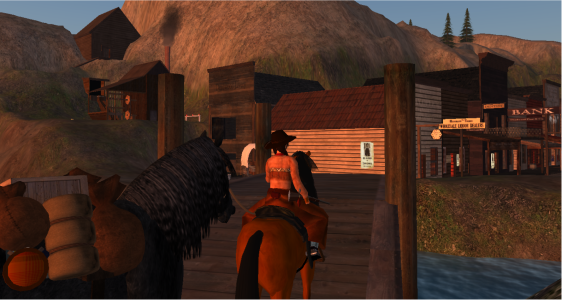
As I have noted elsewhere, I have been spending less time than I used to in Deadwood--not because there is anything wrong with it, but just because I was in a weird place emotionally and mentally, and not enjoying it as much as I used to. Similarly I have completely dropped out of Hogwarts United, mostly because I found that I couldn't bring myself to make the kind of mental effort, and fulfill the necessary time commitment to do it well.

So where did I go?

Well, you might recall that back in May, I was exploring the ancient-themed sims. In part this was because I was just looking for something new to experience, but also because I had been inspired by the ancient environments in Heritage Key. It made me wonder, so what's available in SL? The builds in Heritage Key are beautifully done, but not consistently populated, and not really designed for role-playing. They are much more like immersive museum exhibits than a place where you form a community and interact on an ongoing basis with other interesting people. Heritage Key is about teaching, not learning; it's about visiting, not building a set of relationships; nor is it about enabling the creation of your own content--and I have come to realize that those are the elements that do the most to keep me in Second Life, rather than wandering off to places like Blue Mars (which also hasn't made the effort to accommodate Mac users, so fuck 'em).

Anyway, back in May, at the time I wrote the ancient life article part I, I found that there seemed to be a number of historical Egyptian, Roman and Greek-themed builds in Second Life, but generally speaking they were largely devoid of any humanity (at least when I visited), or were mediocre builds, or both. And when I say "mediocre," in some cases, I am being extremely generous.

Not long after I wrote the article, I stumbled across two new places, Alsium http://slurl.com/secondlife/Alsium/113/100/23/ and The City of Hydra http://slurl.com/secondlife/City%20of%20Hydra/138/218/21/, and by golly I found myself being drawn in.

When I first saw it, Alsium was literally a brand-new build. It is a representation (or perhaps an "interpretation") of an ancient Roman resort town that actually existed, but for which there is relatively little historical information or physical remains to draw upon for guidance in doing a recreation. While there are things that I would have done differently if it was my build--some improbable statuary, a superfluity of banners, and some other things like limited seating at the arena and a lack of certain public structures that most Roman towns had--it's freakin' gorgeous, and it's a fun place to explore and to play. And hey, it's not my build, not my sim, so at this point I will just shut the fuck up regarding what is or isn't there. Cuz after all, if I really wanted to have an ancient build that met all the criteria I would like for one to meet, then I need to cough up the jack and build one myself someday, right? Well maybe I just will, because the experience of being a part of the Alsium community has been very positive.

Alsium--a pretty resort town on the coast, about 35 km from Rome. This is in the suburbs, away from the town center with its arena, baths and forum. The multi-story structure with the private dock is my current domus.

And in many ways, I was pleasantly surprised at how positive the experience has been. The vast majority of Alsium's players--and characters--are gay males. I have no issues with gay folks, but you could argue that I didn't really fit in. Also, many of the guys are players who have migrated from Gorean sims (and my only previous contact with Goreans had been somewhat ridiculous...I'll have to tell you the story sometime). Initially, I was the only female player and/or character present. So in a lot of ways, on the surface, it seemed like it should not have worked for me being there. But somehow it did, in large part because of some key decisions that were made by sim owner Noah Shepherd: he gave the sim a particular time period to work with--its timeframe is during the latter part of the reign of Marcus Aurelius, roughly in the era from 170 to 175 AD, so there was an historical context; he quickly opened up an adjoining sim that offered a variety of rental properties (a bit pricey, but with huge prim limits), so that residents could do exciting and interesting things in terms of not just decorating but structurally adapting the interior spaces they rented; and he made it clear that what he wanted was not a particular type or style of roleplaying to take place--he just wanted good roleplaying.

The character I created was a Greco-Egyptian lady from Alexandria, the widow of a wine merchant who died of a fever while I was accompanying him on a buying trip. My premise was that I was sort of stranded in Italy, and needed to keep the business going in order to meet his obligations and settle our debts. And as time went on, with the help of his "servus" who had helped him run the business, the enterprise was becoming profitable and my character was finding that she enjoyed being a wine merchant.

Keeping the business going: the cellar of my first house in Alsium, filled with casks and amphorae.

I soon discovered that this character and her little storylines did fit in pretty well with what was going on, and that the guys all treated her with the greatest respect and consideration. Yeah, I kind of made it a point to not be around when they would get into their...well...being a bit randy, enjoying their "boys will be boys" grab-ass, slightly Fellini-esque fun and games. But there were plenty of times that we collectively had storylines going in which that I could be a contributing player.

I decided to rent one of the houses that came available, and put considerable work into researching Roman life, business, society and decorative arts. I had a wonderfully good time learning new things purely on my own, inspired by the roleplay, and then, as time went on, I found other people in the sim who were very interested in sharing information as well. Members of the growing Alsium community (which is gradually becoming more diverse) put on classes for each other, discussing matters such as food, daily life, the Roman client system, classes, and slavery.

Ah yes...slavery. A very touchy issue. But you can't represent Roman life without incorporating that element. It would be like trying to do "Spartacus" and claiming that it was just a labor dispute that got out of hand. I'll be honest, I am not terribly comfortable in dealing with the subject in rp--even though there are aspects of ancient slavery that are very different from how we understand slavery in the context of American history. I even have a hard time calling someone a slave, in the same way that I simply cannot bring myself to use the "N" word when playing a 19th century rebel widow. And I am not going to treat my servi badly. Historical authenticity be damned, there simply are things I am not willing to do. Oddly enough I have two very good friends who have decided to come in and play the servi in my household now and then. Sometimes, I may refer to them as "servus," but more often, I will say "this is my man, Serenek," or I will describe them as "members of my household."

Not everyone is so careful--but then that in itself is historically authentic: even in the ancient world, various people in different circumstances saw slavery in multiple ways and treated enslaved people differently than their contemporaries did. And in the roleplay we do, different people who play slaves are obviously exploring historical and personal issues in wildly divergent ways--I'm not entirely sure what all is going on, but I do know that in this sim (as well as the next place I am going discuss) there is an on-going effort to help the residents to distinguish between the historical form of slavery that is part of the ancient Roman story, and the largely BDSM-based style of fantasy slavery that is part of the Gorean canon.

By the way, that is one of the really interesting things that I have heard from some of the guys who came to Alsium from Gorean rp--they say a big part of what they found frustrating in Gor was the restrictive nature of Gorean canon and community life. They actually find this historical context to be more flexible. I'm still pondering the significance of that one.

Hard at work in my new house in Alsium.

So I have been having a great time being a part of this community, learning new stuff, going to the arena and cheering on the guys who have been working so very hard to master the combat system...and I have really had a great time building and decorating, rebuilding and redecorating, making textures of actual ancient mosaics, wall art, frescoes, etc....

...and not having responsibility. I just come and go, fiddle around with my "domus" and have fun.

Oh yes, and I also periodically go over to the City of Hydra. The folks there have established a grittier environment for ancient Roman rp--a representation (again, not a completely historically authentic recreation) of a generic Roman-occupied commercial port city out in the conquered territories somewhere (I think it's supposed to be on the Greek coast or something like that).

It is sort of a classical dystopia--urban, ugly, corrupt, crowded and crime-ridden. Hydra is an unplanned jumble of check-by-jowl town houses, apartments and stores that is hard to find your way around.

If I was the Roman governor of the city I think I would have simply sold the inhabitants, razed the buildings, and started over. But that's just me.

The City of Hydra.

Seriously though, I don't play here too often, not because of the stories or the build or anything like that--it's just that it seems to be mostly populated at times when I have to be at work. Nonetheless, it is interesting to see a place that is so completely different from Alsium.

Alsium is a beautiful place where the corruption, the penchant for violence, the tension between competing interests and factions is all under the surface, bubbling forth into visible form only periodically, not unlike some fictional Steven King New England resort town.

In Hydra, the unpleasant realities of life are pretty much all out there to be seen and savored, if that is how you like to spend your vacations. It reminds me a lot of New Jersey.

I will say that one thing that has kind of turned me off on Hydra (which by the way, should not be confused with a "Hydra" that apparently exists on a Gorean sim), is that they make a point in describing themselves as offering "Excellent, immersive Roman roleplay -- only the Best."

*coughs*

OK. I've met some really good people there. And yes, I've experienced some very good rp in Hydra. But I have also experienced some very good rp in Alsium.

A place like Alsium admittedly has a number of folks who exhibit a wide variety of rp styles and levels of experience. Some people are just starting out and some of what people do could be described as "RP lite." But you know, I find that Alsium's residents generally try to accommodate one another and adjust to make it work. That's about all you can ask for. In fact, I think you can make a pretty good argument that the variety of styles and skills and levels of experience is actually a strength.

Look, I think it's good to aspire to providing a quality experience. But when you give yourself labels like "only the Best" (as Hydra does on their landmark card), I find it just a tad off-putting, especially when there are so many interpretations of what constitutes "good rp," let alone what might be considered "the best."

Still, it's an interesting build and I encourage you to go look at it.

So that's the bottom line. In the end, I did manage to find some entertaining, engaging places for ancient rp in SL. There's even informal, self directed learning going on in these places. There's some great people to interact with. And I think, most interestingly, you might find yourself reconsidering how you look at certain groups of people, as your assumptions about the members of various communities are challenged.
~~~

Sunday, January 24, 2010

The Bakumatsu in Second Life -- sharing an interest in history

~~~
Looking out into the back garden at the House of Yagi Gennojo in Kyoto Bakumatsu--a sim representing aspects of life and politics in Japan's capital city during the 1860s--a time of great change and dramatic conflict.

The other day, I was casting around for something new to go see in terms of history-related builds in SL, and my friend Ernst Osterham asked if had seen the sims representing Nagasaki and Kyoto in the 1860s. I admitted I had not, and at the first opportunity, popped over to see what is best described as the "Bakumatsu" build: three adjoining historically-themed sims dealing with the end of Japan's Shogunate era.

I am indebted to Ernst for the suggestion to visit this intriguing and well-constructed effort.

You know, much of what keeps me interested in Second Life is what various residents do in terms of exploring stories that are important to them. The ability to interpret or recreate historical environments fosters a delightful range of learning opportunities and various "aha" moments.

Some of those learning opportunities are entirely self directed, as in situations where a concept (like the Deadwood sim) and/or an activity (like Western frontier roleplay) draws you in and encourages you to learn new things. I honestly knew damned little about the American Western frontier and things like gold mining before I started playing in the Deadwood sim. Now mind you, the build and the roleplay didn't necessarily teach me these things. What it did do was to inspire me to study and learn about a range of new subjects, and to immerse myself in stories from a part of America's past that had only marginally interested me before.

Ah, but a slightly different kind of learning took place for me in the Bakumatsu sims. This build is literally an example of people from a background and heritage very different from my own, transporting me into a world of which I had only superficial knowledge from college courses I took almost 35 years ago. According the Bakumatsu sims manager Ryomo Sautereau (who is also one of the builders) this project was the result of collaboration among a group of SL residents from Japan who wanted to share a part of their history. They are not associated with a museum or university, but are simply a collection of Japanese history enthusiasts who have a fascination for this period known as the "Bakumatsu," which encompasses the years from 1853, when Commodore Perry's US Navy fleet of "black ships" pressured the Japanese to open their nation to trade with the western nations, to 1868, when the control of Japan by the Tokugawa Shoguns ended with the Meiji Restoration.

As I looked into this story (and some of my old Asian history studies came back to me), I could see why these folks are so intrigued by this time period: it was an era of great change for Japan not just politically, but also in terms of society and technology and religion. It was an era in which the Japanese people could see aspects of their ancient traditional way of life juxtaposed with the modern world, and they had to figure out how to reconcile those two realities. It's fun, exciting, and meaningful stuff.

Ryoma explained to me that the three sims actually have been around for some time: Kyoto Bakumatsu and Nagasaki Bakumatsu were built 3 years ago, and Kyoto Sanjo opened about a year later. A number of highly skilled builders were involved in this project--among those whose work you will see here are Senri Oh, Jeter Jun, Kuroe2 Noel, D15 Koba, Hiroe Jewell, and Ryoma. There are others as well, and I intend no slight to them and their work by not listing them all (and I apologize to those I missed in my cursory note taking), but a lot of people have contributed here. The remarkable thing about it is that even with all these different folks crafting the build, it has an astonishingly consistent feel to it. The scale, the authentic feel (even in the vendor areas), and the overall look works really well.

A clean and authentic feeling streetscape.

The way that it is structured is that the three sims generally have historical recreations arranged around their outer edges, while the central areas are commercial. In these center sections, you will find numerous blocks of historically-styled buildings that can be rented for vendor and social spaces. These include stores selling garments, skins, furnishings, weapons, etc., and while the products and environments all seem to express Asian traditions and generally utilize an Asian design vocabulary. You can also find social and cultural venues throughout the sims, such as a recreated tea house and a place showing machinima.

Ryoma tells me that not all the merchants are Japanese--many come from America and Europe. The interiors of the commercial spaces do not have to be historically authentic--most of the stores look like standard SL retail operations with the usual vendomatics and signage--but the exteriors generally have been kept clean and close to the period, so the overall effect of the streetscapes does not clash with the historical elements of the sims.

And I tell you what, boys and girls, the historical environments in these three sims are excellent--both in how they look and feel, and how they were chosen to tell a particular aspect of the story of this era.

For example, I started in the Nagasaki sim and the first thing I noticed was a massive recreation of mid-19th century steam and sail-powered sloop of war. And I thought, "oh..that must be one of Commodore Perry's warships from 1853." Nope. Not at all--it is a representation of the Kanrin Maru, Japans first screw driven naval vessel (that means it's moved through the water by a propeller, not side-wheels), which was built in a Dutch shipyard in 1858. It's an important artifact as it highlighted the reality that only five years after the "black ships " first arrived, the Japanese themselves were adopting the latest modern technology. The Kanrin Maru is also significant as it carried the first Japanese diplomats to the US. The build itself, crafted by Kuroe2 Noel, is gorgeously done. The hull has clean lines, the masts are fully rigged, and overall the ship is properly proportioned.

The Kanrin Maru, tied up at the dock in Nagasaki Bakumatsu

The ship is moored at a dock, not far from both traditional Japanese style structures and a sort of "foreign quarter" that includes a recreation of the Oura Roman Catholic Church, which was built in 1864-65 in Nagasaki. The real life version of this structure still stands today, and is the oldest existing Christian church building in Japan.

From there I wandered into the commercial area, passing numerous shops--mostly fully rented, it seemed, and without realizing it I passed into the Kyoto Bakumatsu sim. While Nagasaki was a key sea port and trading center in the 1850s and 1860s (and a nexus for interaction with the West), Kyoto was the old capital city of imperial Japan until the Meiji restoration in 1868 (when the capital was moved to Edo--now Tokyo). Consequently, Kyto was a center of intrigue and conflict between the supporters of the old Tokugawa Shogunate system of government, and the socio-political forces that wished to return real control of the country to the Emperor.

This makes for some real interesting stories--ronin serving as special police forces, assassinations, torture, sword fights, the whole deal. Great stuff! In a lot of ways, this era of Japanese history is like a combination of our American Civil War, the Wild West, and the Condottieri wars of Renaissance Italy all rolled together.

At the Mibu Dera Temple in Kyoto Bakumatsu

Historical recreations representing this story include the Mibu Dera temple (build by D15 Koba), a Buddhist shrine that was erected in Kyoto around 991 AD, and which in the 1860's had connections to the "Shinsemgumi," a "special police force" made up of ronin who worked for the cause of the Shogunate. Nearby to the temple is a damn fine representation of the house of Yagi Gennojo, which served as the headquarters of the Shinsengumi, and where two important members of the group were assassinated in 1863 (and for whom there is a memorial at the Mibu Dera temple). This recreation of the house of Yagi Gennojo was also built by D15 Koba, using some fantastic texturing. It very closely follows the exact design of the rl structure...and as for its overall feel, it stands head and shoulders above most other recreated historical houses in SL, such as the sterile and lifeless Frank Lloyd Wright builds.

Wonderful texturing and a great overall sense of place at the Yagi Gennojo house.

Another really well done historical recreation is featured in the adjoining Kyoto Sanjo sim. This is a representation of the Ikedaya Inn, built by Jeter Jun. It was the site of the "Ikedaya incident" in 1864, in which the Shinsegumi conducted a raid to arrest a group of pro-imperial ronin who may have been planning to make trouble. A serious little battle broke out, and although the actual impact of the incident is debated, it certainly added to the reputation of the Shinsengumi as a force to be reckoned with.

I asked Ryoma what are his favorite parts of the Bakumatsu build, and he told me really liked the temple because of his fascination with story of the Shinsengumi, but he was particularly fond of the Ikedaya Inn recreation because the actual structure no longer exists. Therefore, as he put it, "There is nothing of it any longer in rl--only in Second Life can you get the feel of this building that existed long ago."

Getting a feeling for a place that no longer exists--inside the Ikedaya Inn.

A big part of what the folks who built the Bakumatsu sims wanted to achieve was to share their history with other people who might not know these stories. Just as all the renters are not Japanese, Ryoma told me the same holds true for their visitors. And in fact, when I was there I noted that there were interpretive signs at all of the numerous historical recreations, both in English and Japanese.

To be honest, the English translations of the Japanese text were not always clear. But they provided enough clues, key words and names that I could then use Google to clarify the story of each structure and discover more information to enhance my understanding. So in a way, it actually became another self-directed learning exercise. I had a lot of fun exploring, and I really appreciate Ryoma Sautereau taking the time to answer my questions to help me better understand what he and his associates were trying to communicate here.

And oh, yes...my last question I asked him was if anyone ever rp'ed in these sims. He replied, "not yet."


To visit--which I highly recommend--you can enter the Nagasaki sim at:
http://slurl.com/secondlife/Nagasaki%20BAKUMATSU/150/122/22

To go directly to the Kyoto Sanjo sim:
http://slurl.com/secondlife/Kyoto%20Sanjo/200/127/22

And to go directly to the Kyoto Bakumatsu sim (this will put you in front of the teahouse):
http://slurl.com/secondlife/Kyoto%20BAKUMATSU/136/83/22
~~~

Tuesday, November 17, 2009

I have a new hero -- his name is "Boilerplate"

~~~
"Boilerplate" at the 1893 World's Columbian Exposition--this and all other images I have employed to illustrate this post are from the BoilerplateRobot.com web site, and are used courtesy of Paul Guinan.

Today I happened into one of those big friendly bookstores (well, not friendly, exactly, but sufficiently indifferent that they don't yell at you if you actually spend some time looking at the books there, unlike the old traditional small family bookstores that people seem to lament the passing of). I wandered into the graphic novels section and saw something new: a large handsome book titled "Boilerplate: History's Mechanical Marvel" by Anina Bennett and Paul Guinan.

I completely and utterly fell in love with this visually stunning triumph of photoshop wizardry. Boilerplate is my new hero: a mechanoid everyman and metallic witness to events from the 1890's to 1918. In his adventures and travels, he interacts with everyday people as well as some of the most famous figures of the era in which the U.S. first becomes a world power.

The robot hero with Pancho Villa, c. 1916.

The premise is an elegantly conceived and executed combination of very real history and actual historical images, into which a steampunk element is introduced that does not markedly alter the course of the real history. As it is explained on the authors' web site boilerplaterobot.com:

"Boilerplate was a mechanical man developed by Professor Archibald Campion during the 1880s and unveiled at the 1893 World's Columbian Exposition.

Built in a small Chicago laboratory, Boilerplate was a prototype soldier for use in resolving the conflicts of nations. Although it was the only such prototype, Boilerplate was eventually able to exercise its proposed function by participating in several combat actions.

Boilerplate embarked on a series of expeditions to demonstrate its abilities, the most ambitious being a voyage to Antarctica. Boilerplate is one of history's great ironies, a technological milestone that remains largely unknown."

The real joy of this book is the variety of images that were selected, ranging from grainy black-and-white photos, to hand-tinted postcards, to drawings and political cartoons. There are even lithographed theatrical posters, which the author is careful to point out do not necessarily reflect historical events in a completely accurate way (laughed my ass off at that one).

With TR and the the Rough Riders in Cuba, 1898.

A review of the book on the Comic Book Resources web site offers an excellent re-cap of where Mr. Guinan was coming from in producing this work. The author was seeking a way to "express his love of history despite the difficulty of selling historical adventure stories." He then developed the Boilerplate robot as a device (both literally and in the literary sense of the term) to tell stories about key events in the late 19th and early 20th centuries that shaped the world we live in today.

According to the very thorough CBR piece, the author "compared the use of his robotic hero with author Gore Vidal's device of using fictitious protagonists in otherwise extraordinarily accurate historical settings." In the interview, Mr. Guinan also states, "A more recent pop culture example is the 'Young Indiana Jones' TV series, where the character meets famous people and is involved in famous events but doesn't change anything in history."

Boilerplate the robot is in many ways, just one of the crowd, both in the narrative and the illustrations, such as this familiar scene of the midway at the 1893 exposition.


It is a subtle and wonderful metaphor for the individual in modern industrialized society, where even the most remarkable of us may have a certain limited impact through our choices and actions (like saving Pancho Villa's life) but ultimately the course of history hardly notices us.
~~~